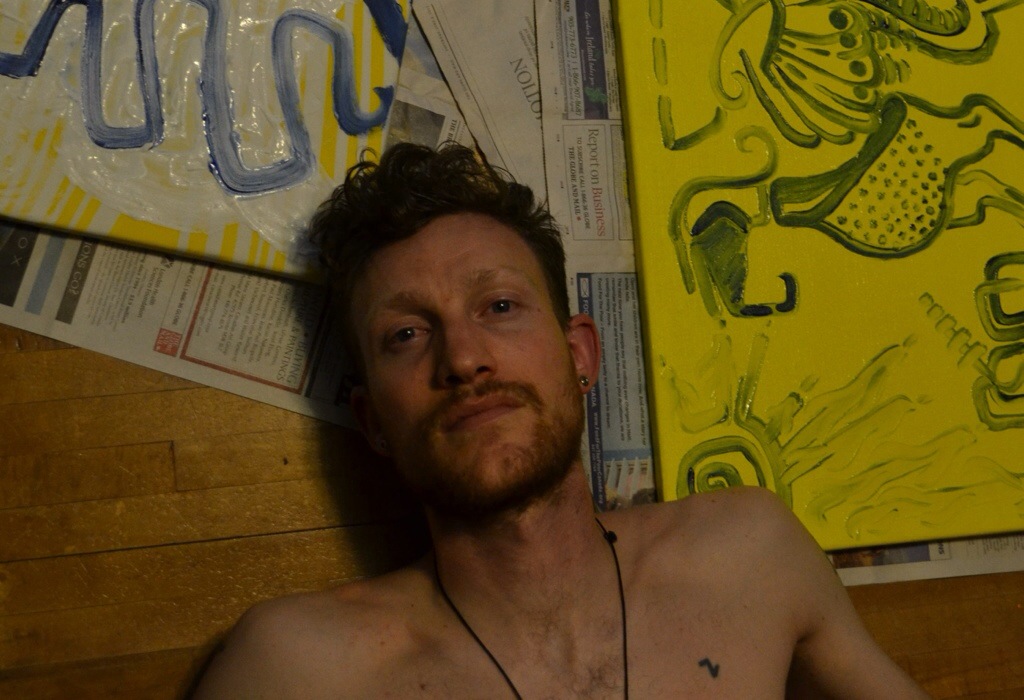
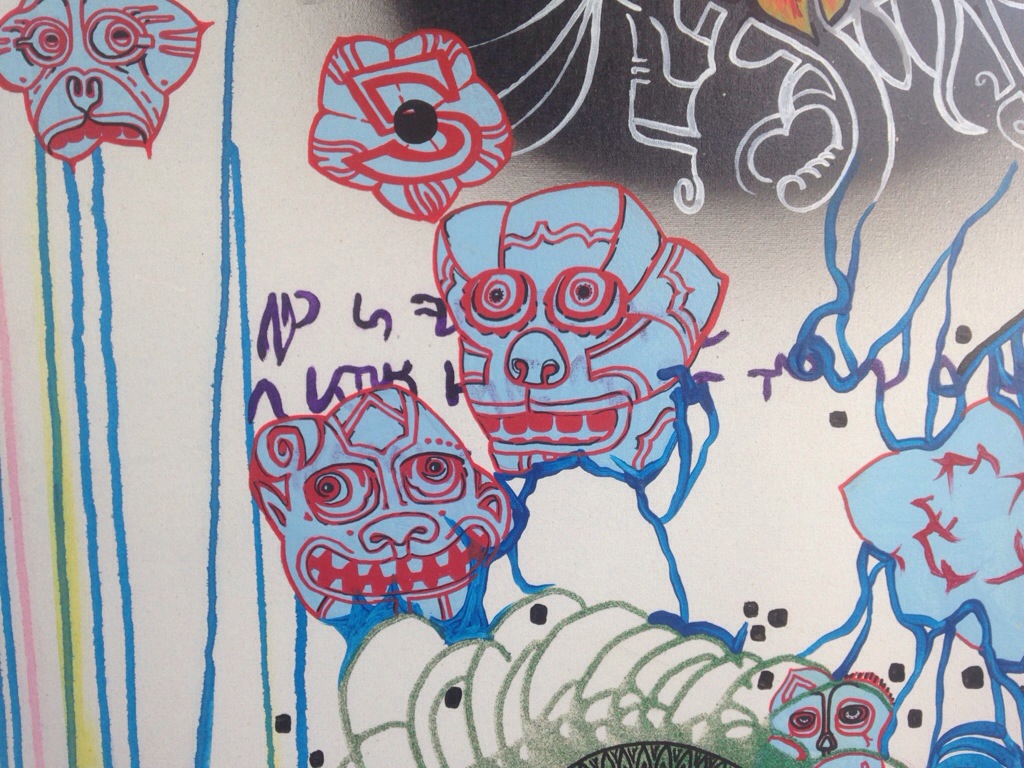
Finn Sound’s paintings are riddles in geometry, abstract symbol, and colour. They’re like individual cells of an unseen body, each one containing the DNA of the larger coded and playful landscape.
Finn Sound is my boyfriend. And this weekend, that landscape is on display at Art Walk on Edmonton’s Whyte Ave.
When I first met him, he told me he was working on about 20 different canvases, piece by piece, all at the same time. It makes sense when you see the twisted arms, peaks, and scraps of memories that keep making appearances.
I love his stuff because it’s usually both tense and whimsical. Mad god-like creatures, ceolocanths, squid, his family, churches… they all intrude, and he doesn’t seem to be able to predict when they do.
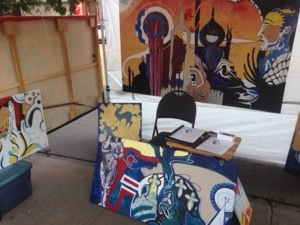
I’m helping him show off his work this Friday, Saturday, and Sunday from 10-5. We’re on the south side of Whyte Ave, between 105 and 106 Street. Come by and see the body of work he’s calling “Red Mountain Fragments.” It’s a world worth swimming in.
This spring, I’ve had the chance to peek into what life without ID looks like in Canada, interview one of Canada’s most interesting authorities on environmental policy, and produce the most music-centred story I’ve ever done for Terra Informa.
A close-up look of the stone harp that Páll invented.
First off, the story I made for the many people who asked to hear the recordings I made of artist Páll Guðmundsson while I was in Iceland. This story was a mix of liquid luck and preparation that paid off. If ferry workers hadn’t been striking in south Iceland where we originally wanted to go, our friends at the tourist bureau in Reykjavík would never have recommended we go check out Páll’s rock sculptures in his tiny summer village of Húsafell. Fortunately I had packed my pocket-sized Zoom audio recorder just in case I met someone life changing, whose story I absolutely needed to tell.
Have you ever gone somewhere new and had the feeling that you’ve been there before? Imagine going away on a trip and finding that everything you see reminds you of home: the stores have the same shape and sell the same clothes, the restaurants serve the same sort of food, the people listen to the same kind of music…
What about somewhere embraces its own character and qualities? That’s what I saw in Páll Guðmundsson, an artist whose local and naturally inspired work makes his home feel one-of-a-kind. Listen from about 10:18:
Scott Vaughan, plus my hand.
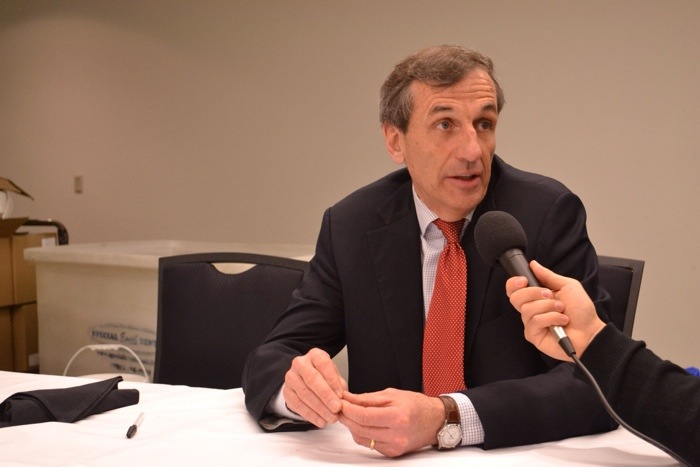
Next, my interview with Scott Vaughan, Canada’s former Environment Commissioner and the new President and CEO of the International Institute for Sustainable Development (IISD). IISD just took a big leap forward for themselves, and for aquatic science in Canada, by successfully negotiating to become the new operator of the Experimental Lakes Area in northern Ontario. It’s one of Canada’s most important (and most famous) scientific research facilities.
There, scientists have a unique ability to conduct experiments on entire lake ecosystems — in some cases, their research lasts over decades. The research there has caused major changes in the way we live in Canada: like how acid rain affects freshwater fish, and how phosphates in our detergents can cause algae blooms.
But in 2013, the federal government said it felt the Experimental Lakes Area’s research was no longer necessary, and to be be shut down. That set off a mad scramble from environmental groups, activists, and researchers around the world to find a way to keep it alive.
I got a chance to meet Scott Vaughan at the Zero 2014 sustainability conference in Edmonton to discuss how the year of upheaval will affect the research at the ELA, and what he learned about the federal government’s attitude towards research during his time as Canada’s Commissioner of Environment and Sustainable Development. We had a frank talk about whether he and the other parliamentary officers who’ve irritated the government ever get together and commiserate, but regrettably I had to cut it out of this Terra Informa story. The rest still makes for a fascinating story, I think. Listen from about 1:28:
Finally, this week I finally got a story out that I’ve had in my head for a long time. Last year, I noticed a flyer up in the Stanley A Milner library in downtown Edmonton, advertising an ID storage service at Boyle Street Community Services. I was intensely curious why anyone would need to have the centre lock their ID away. It led me down a rabbit hole of the frustrations that face seniors, homeless people, the recently-incarcerated, anyone who wasn’t born in Canada, and ultimately, our democracy.
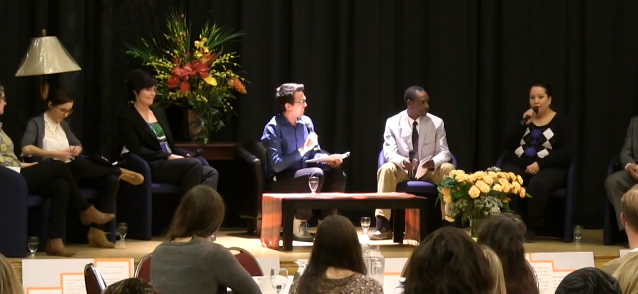
We’re at an interesting moment of history in North America. Many people are convinced that the women’s rights and queer movements have done their job, and can basically pack up and go home now. We keep forgetting that there are huge battles still to be won: sexual violence is extremely pervasive (even moreso in Edmonton than other cities), and trans folks still have no legal protection from being fired for how they express their gender. A fascinating article in the Atlantic this month argues that as our ability to communicate with each other through digital media has increased, unpopular and poorly informed opinions about these issues have become more visible. Our reaction to this, says author Jon Lovett, has mostly been to tell people with those unpopular opinions to shut up. Think rape is mostly an issue invented by women who regret sex the morning after? Shut up. Think protecting trans people from discrimination means that men will sneak into women’s washrooms for fun? Shut up. These are both ridiculous ideas, of course. But I agree with Jon Lovett that there is more to be gained in the long-run from winning the argument, rather than saying the argument is too offensive to be had. To that end, twice this month I’ve dived into the discussion on how to solve gender-based discrimination and violence. Last night, I moderated a panel for the Sexual Exploitation Working Group at Edmonton’s Santa Maria Goretti Centre. #YEGsecret Exposed- A Hard Talk Panel on Rape Culture was a chance to negotiate strategies on ending a culture where rape is normalized. Our speakers had amazing things to share from the perspective of the police, sexual violence education, surviving a sexual assault, working in broadcast media, and more. You can view the panel on YouTube here (start around 5:43):
As well, I had a chance to zip to Montreal last month for ACGC to go to a conference that our sister council was hosting on the accomplishments of its committee working on gender and international development issues. Afterwards, I reflected on some fascinating strategies I learned about how to start a conversation about gender. You can read my post on the Canadian Council for International Cooperation’s blog here.

 Chris Chang-Yen Phillips: Storyteller and People Weaver