Chipping away through a complete disaster

A snowy, muddy field leads up to a castle of snow at dusk.
Ice on Whyte’s iconic ramparts of snow are being melted away by the warm weather, and built back up by Delayne Corbett.

When the January cold dropped off into that warm, wild wind last week, I found myself sprinkling gravel on my sidewalk as quietly as I could in the morning. It was already an inconvenience having to address the fresh ice that had spread out over the walks, and when I saw a woman get out of her truck to move a branch that had blown down from our tree into the road… well, I’m not proud of it, but I slunk away with my bag of gravel, lest she think I threw the branch there or something, and harangue me into arriving even later to work.

All in all though, the warmth was a treat. Which made me wonder who’d be really annoyed by the weather. That’s how I met Delayne Corbett.

Delayne is the Artistic Director of the Ice on Whyte Festival — a fact I discovered when I penguined over to End of Steel Park and shouted across the gates that I had a microphone and I’d love to talk to anyone inside. Ice on Whyte, you see, is the local ice sculpting festival that spreads through Old Strathcona in January. I had a hunch that if anyone resented the temperature hitting 6ºC, it’d be the folk who had a week left to finish building a mini-empire of ice and snow. As an ice carver, Delayne said, 6ºC with full sun was a complete disaster.

Delayne was the only one working on the site at the time, and he let me watch him for a while as he ripped cardboard covers off 150-pound rectangles of ice. He clamped one of them with metal tongs he swore were older than him, and threw it on the snow so he could “walk the dog” and shuffle it into place with the rest of the ice slide he was building. The slide would bring you to the bottom of a mountain of snow his team had stomped into the ground. All things considered, he was in good spirits.

-15ºC, Delayne told me, is the ideal temperature for ice sculptors. The ice doesn’t crackle much when you add water, and the cold wicks away the sweat you’re building up. The warm weather made him want to rip off layers, but he couldn’t because it was so wet and goopy that he had to keep his rainpants on.

Even worse, the wind had blown sheets of cardboard all around the site. That would have been okay, except that the record-setting gusts also tossed an 8-foot tall plywood box into the fences “like a bowling ball,” and he spent most of his morning gathering cardboard that had sailed into nearby streets.

He said something that stuck with me though, about the ice slide and the whole business of working with ice. He was in the process of adjusting the slide to make it a little slower at the bottom, by adding a little more distance. I mused that people building roller-coasters didn’t have that luxury.

“Those are all so planned meticulously,” he agreed. “Basically when I get here, I don’t know how much snow I have… so I kind of have to just go with the flow, rather than pre-plan.”

That, I think, is a skill we could all stand to learn. You’ve got to work with what you’ve got.

I also told this story for a 3-minute story challenge on CJSR. Have a listen.
CJSR Turns 30

Text: CJSR 88.5 FM 30th Anniversary. CJSR star cut out of the middle of the 0 in "30".

In case you want to hear me definitely ace my second-ever live interview on the radio, on Tuesday, January 7th, Terra Informa will be broadcasting live from Edmonton’s City Hall to celebrate the 30th anniversary of our home station: CJSR 88.5 FM. From 5-6 PM, tune in for a special one hour episode of stories about leaving a legacy.

You’ll hear music from across Canada, and stories about artist Richie Velthuis’ delicate carvings in ice and the echoes of Chinese immigrants on Edmonton’s food culture today. I’ll be interviewing Linda Duncan – Alberta’s sole NDP MP, an environmental lawyer, and a recurring guest on Terra Informa over the past few years.

Edmonton listeners can tune into the broadcast live on CJSR 88.5 FM at 5 PM on January 7th, and listeners in other communities will hear both halves of the live show over the next two weeks. There’ll be more celebrations throughout 2014 marking the history of one of Canada’s most outstanding community radio stations. Hope you can join us.

Act Out or Opt Out

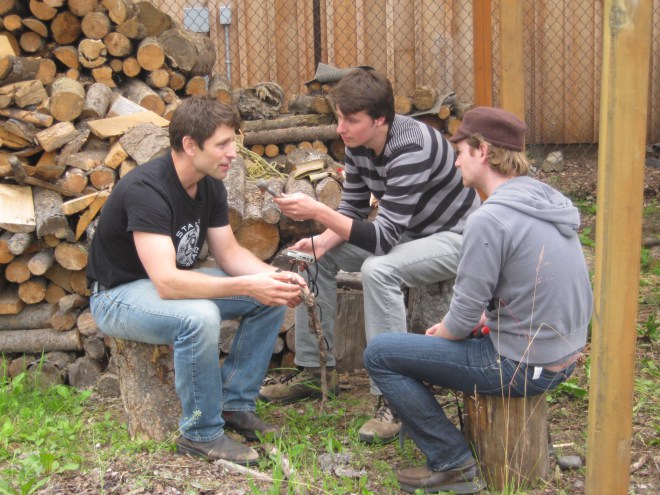
David Kaczan and Marcus Peterson (middle and right) were two of the Terra Informers who journeyed out to capture voices of locals along the Northern Gateway project route.

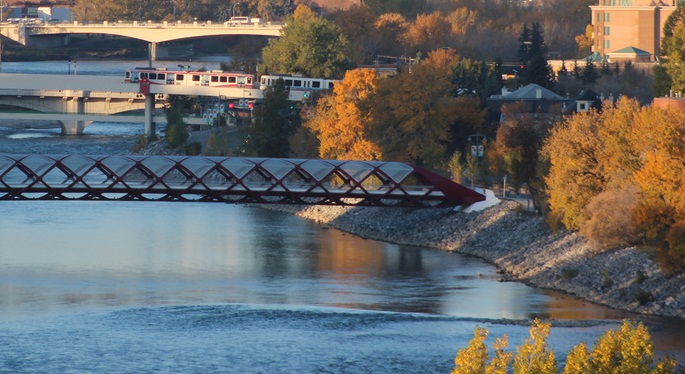
Every time I go to Calgary recently, people ask me what I think about the red skeletal swoops of the new Peace Bridge. I don’t have strong feelings about the bridge itself, but I was reminded of its pedestrian crossings this week when the Joint Review Panel decided to recommend building the Northern Gateway pipeline project.

Two years ago, I remember debating the objectivity of the Joint Review Panel process assessing the proposal to chug Alberta’s bitumen out to Kitimat. In early 2012, Terra Informa released a two-part radio documentary called Rough Waters & Divide Valleys: Voices from the Northern Gateway Pipeline. We sent a team of independent radio journalists out from Edmonton in the summer of 2011, and they travelled the route of the proposed pipeline, having conversations with locals along the way. I remember being surprised to hear how widely opinions diverged, especially in towns like Prince George where some talked about fearing for their forests, and others spoke plainly about hoping the pipeline would bring jobs to town.

What I also remember from discussions around that time is that many people in BC felt that the whole consultation process was rigged. Thousands of Canadians were fired up enough about the issue to apply to speak at the Joint Review Panel’s hearings. The Federal Government reacted by writing a new law to severely restrict how many people can have their say in future consultations.

It’s easy to see how this led to two main reactions among opponents of the project when the panel released their final conclusion that the proposal’s benefits outweigh its risks: complete apathy, and anger. This is where I’m reminded of Calgary’s Peace Bridge.

Say what you will about the aesthetics of the pedestrian crossing, or its cost, or how close it is to other bridges crossing the Bow River downtown (and Calgarians have said a lot about those things). What struck me when I first visited it is that when you cross over to its north side, you’re dropped off right onto Memorial Drive, with no obvious way to cross the four lanes of busy traffic to get to your destination. I watched for a while to see how other pedestrians reacted.

Shots of three bridges over the Bow River
My whole family assumes that I love the long red Peace Bridge, for some reason. (Photo: daveblogs007)

Most people looked earnestly for a safe place to cross, or a button to press. Then they saw how far away those were, and did the logical thing: they jay-walked. At no small peril to their lives, I might add!

It demonstrates a basic principle I heard outlined by a guest on CBC’s The House a while back: when people believe they have meaningful, fair choices, they’ll go along with one of them. When they feel like the choices are unfair, they’ll either act out or opt out. If you need to cross the street and the nearest crosswalk is unreasonably far away from your path, it’s understandable to act out and jog across the road. Not safe, but understandable.

The Joint Review Panel’s work was supposed to be an objective evaluation of the Northern Gateway project, weighing out the jobs, royalties, impact on local First Nations, risks to salmon-bearing rivers, risks of tanker spills, and adding it all up into one sober conclusion. But the Federal Government has been screaming its support for this project for years, passed a law limiting public participation in similar reviews in the future, and asked the National Energy Board to work with the RCMP and Canadian Security Intelligence Service to spy on environmental groups and First Nations participating in the public hearings. Under these circumstances, what reasonable person opposed to the project would believe it was a fair process? As ForestEthics Advocacy’s Amanda Follett says, it seems like the Panel wasn’t even at the same hearings as everybody else.

This is why you’re not likely to see many opponents shrugging their shoulders and saying, “Well, we did what we could.” BC First Nations, community activists, and environmental groups are gearing up for a fight if the Federal Government ends up approving the pipeline next year. When the game looks rigged, reasonable people will likely make the choice to act out or opt out.

If this thesis is right though, it offers hope to those fighting for genuinely participatory decision-making. When we see that our choices are meaningful, we’re more likely to jump in and help make them. That is something worth fighting for.