In April this year, an anonymous source leaked a grainy video of a closed-door meeting among some of Calgary’s real estate developers. A grainy video worthy of media attention should be enough to make anyone caught on film gulp, and in this case the footage made some Calgarians furious. Cal Wenzel, founder of Shane Homes, was rallying fellow housing developers to pour fountains of money into the upcoming municipal election to kick out anti-sprawl candidates on city council. I’ve been trying to untangle why this video has made some people incensed, while a slew of other special interest groups supporting candidates in Edmonton have become local celebrities.
Wenzel tells the audience in the leaked video that he and other developers had doled out $1.1 million in donations to the conservative Manning Centre and Manning Foundation in order to defeat city council members on “the dark side.” The Manning Centre’s new Municipal Governance Project is aiming to colour Canada’s municipal politics a little bluer by offering training and guidance to right-leaning candidates. At least five of this year’s Calgary city council candidates have received training through the program: Joe Magliocca, James Maxim, Sean Chu, Jordan Katz and Kevin Taylor, who also received transportation and signage help from Cal Wenzel.
While this wealthy group of developers may well be violating the spirit of the law, I wonder how much of the backlash (such a recent piece from David Climenhaga) has come from a feeling that this amount of influence is unfair, and how much has come from ideological opposition to the ideas.
This year, special interest groups have also stepped up in Edmonton to test candidates’ support for queer issues, sustainable urban agriculture, and arts and culture. Several have published the results of surveys they sent out to the candidates, including Yuri Wuensch’s highly-visible Vote Zombie Wall campaign – focused on keeping out the hordes by combatting sprawl. Wuensch has appeared at election events all over town with little controversy. So have the leaders of Activat ED, a youth-led group endorsing progressive candidates. And in fact, both of the latter appeared on my own radio show, Terra Informa.
Each of these groups has advanced a special interest by lending resources and limelight to candidates, or highlighting their credibility on certain issues. We have a word for that: civil society. Civil society groups, such as think tanks, churches, blogs and non-profits, carve out an important part of the public conversation outside of government and business. They’re a vital part of becoming informed and active in negotiating decisions in a democracy, whether we’re debating suburb growth or clandestine chickens.
It may be more productive to make sure that civil society groups are transparent in their activity, and accountable to our elections laws, than to try to shame them out of town.
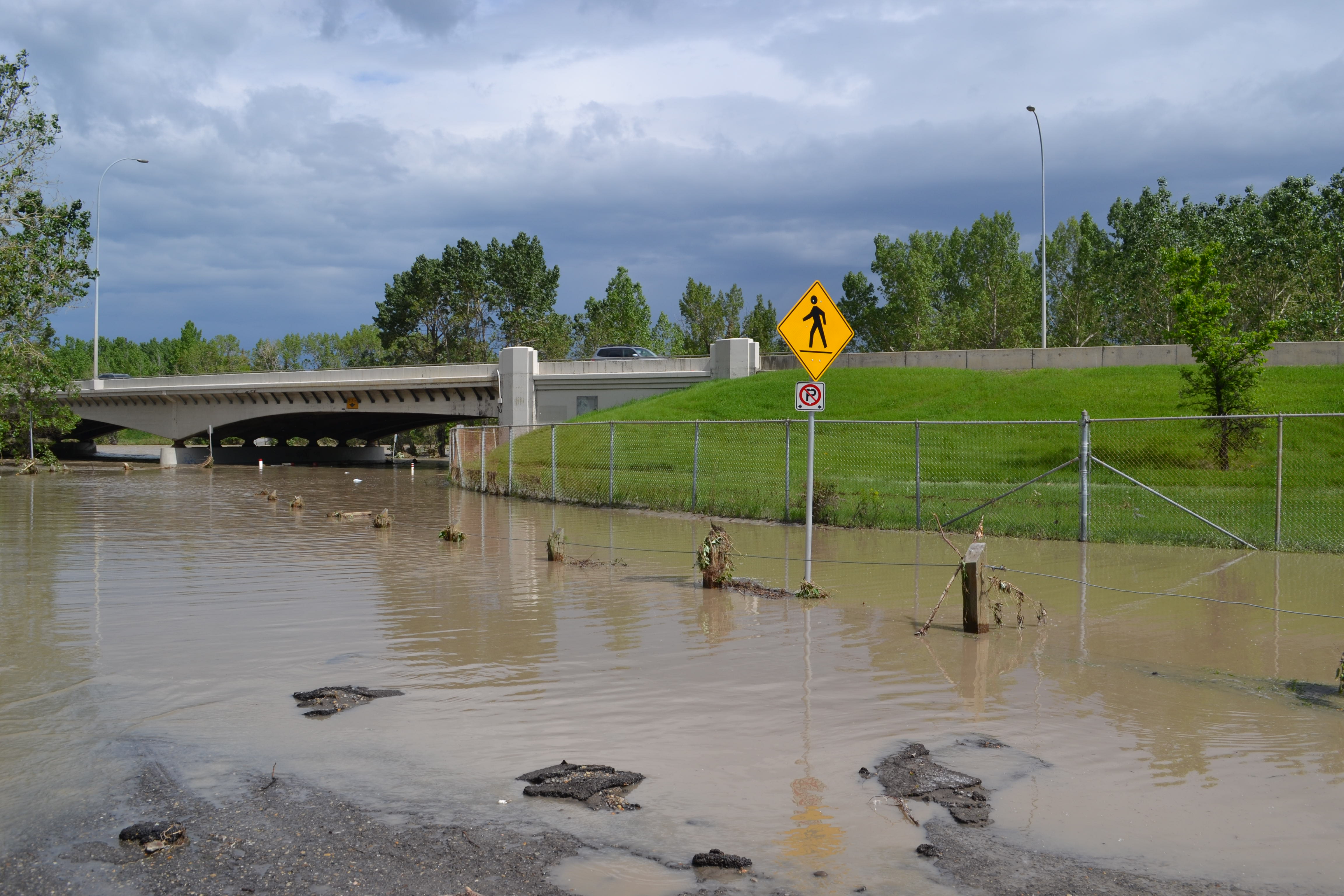
The land where my grandparents used to live in their motorhome, underwater in June.
This morning I missed my bus, so I stopped inside the cafe on the corner to escape the torrents of rain and warm up a bit. It was the kind of rain that pours down your face so fast it stings your eyes, and makes you jump to the inside of the sidewalk every time a truck goes past so you don’t get engulfed in its puddle-waves.
My neighbours Val and Steve were there too, and as the three of us looked outside, we got to talking about how crazy the rain has been in Edmonton this month. We’re not low enough to experience what Calgary got, said Val, but we might see flooding yet.
It reminded me of something that got left out of a radio story I did on the Calgary flood recently, a quote that really sums up something I find hard to understand about these kind of freak, terrible events.
I interviewed Shawn Marshall, a climatologist who works at the University of Calgary but lives down the highway in Canmore, and got stuck in Calgary because the roads washed away. And when something like that happens, and you’re thinking about climate change, you can’t help but ask: is this it? Is this horrible event, that forced thousands of people like my grandpa out of their homes, that’s going to draw permanent red lines around some flood plains, is this what climate change looks like?
The thing he said, the thing I wished my co-producer and I had room to leave in the story, is that we should think about it upside-down, basically. Rather than standing out in our hip waders and asking the water, “Is this it?”, we should look at the planet and ask, “What’s likely to happen these days?” And our atmosphere, explained Shawn, is telling us it’s getting warmer and wetter. Which means more rain and snow. And more floods.
Something to think about as I trundled out in my rainboots today.
Tomorrow is the big election, and I’m finishing this profile series with the ultimate underdog: Meagen LaFave, Wildrose candidate for Edmonton-Strathcona. She’s running for a party that’s climbed to the top of the provincial polls, but in a district that’s still very tough.
Seeing what makes a libertarian like LaFave want to run in a safe NDP riding was probably the most interesting experience I had working on this series. I talked to her about how her experience in health services affects her views on health care reform, what a libertarian thinks about recognizing rights for transgender Albertans, and why she chose Strathcona over any other part of the city.
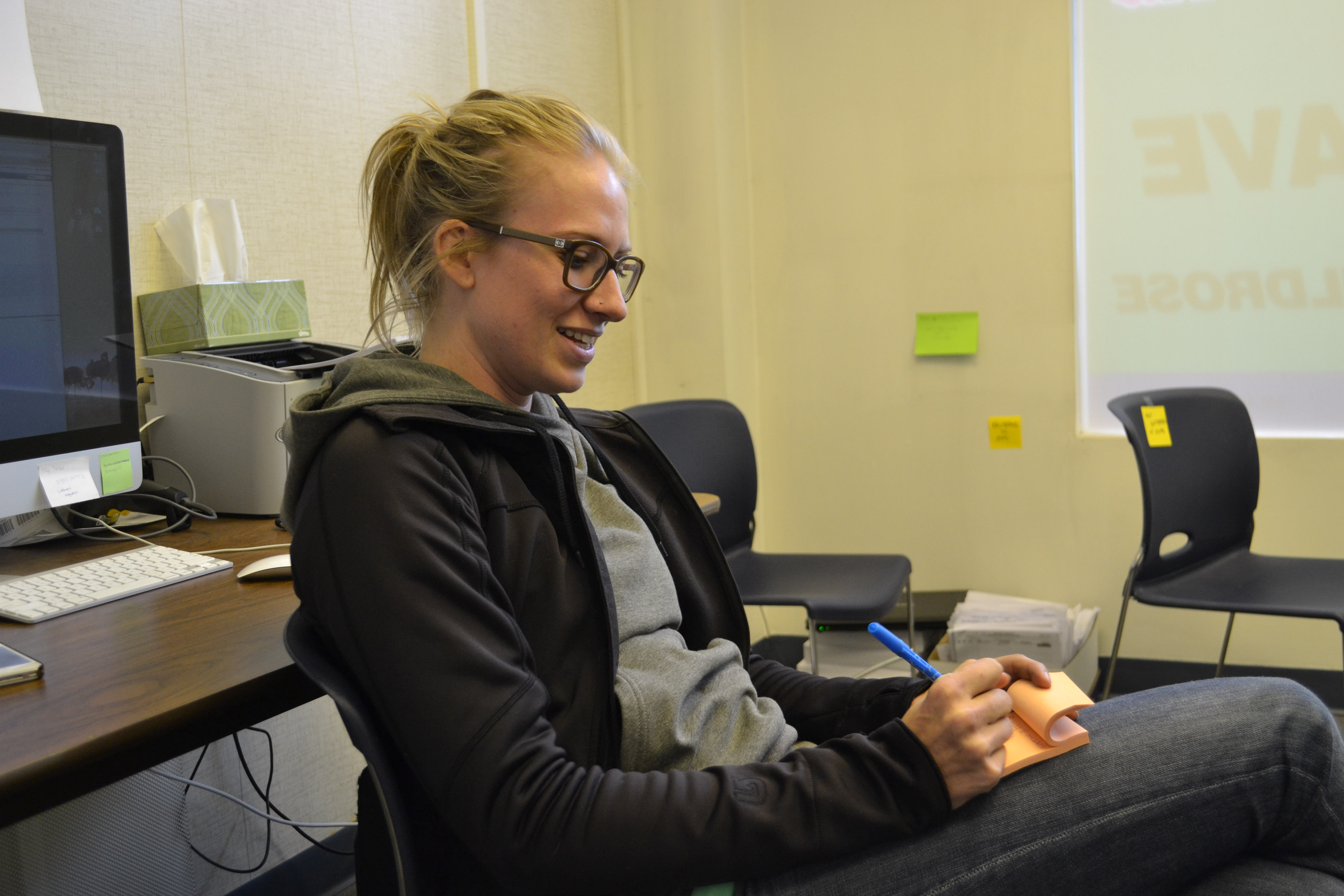
Meagen LaFave says she even writes "Sorry I missed you" post-its while she's watching TV these days.
As Meagen LaFave’s team watches a wind storm die down from her campaign office window, she coughs and finishes writing a stack of “Sorry I missed you” post-its. At 23, she’s the youngest Wildrose candidate in the province, and she’s still getting over a cold from pulling out all the stops campaigning.
On the wall, a whiteboard shows polling results from April 3rd. LaFave’s campaign manager tells me they stopped updating it once it got busy and they realized provincial numbers don’t mean much in what they wryly call the “People’s Republic of Strathcona.”
The NDP’s Rachel Notley is the current MLA for this riding, and their party has held it for most of the last 26 years. Notley’s predecessor Raj Pannu was popular enough to earn the nickname “Raj Against the Machine”. It doesn’t get much safer for the NDP in Alberta, but LaFave says Strathcona’s the part of the city that fits her best.
“I’ve lived in this riding, I love this riding,” she says. This is where she long-boards, shops, and watches theatre. It’s also where she works for a research group and bio-specimen business within the U of A.
There are a lot of conservatives in this area looking for an alternative, she says, and she thinks it helps that she’s a libertarian but not a hard-line social conservative.
LaFave says she couldn’t disagree more with Allan “lake of fire” Hunsperger about condemning gay relationships, for example. She believes it’s his right to say what he thinks, though.
Getting your hands dirty, starting work at 14
What made LaFave want to run, knowing the odds?
“I’m a pretty type-A person,” she says. “I went from being a bookkeeper to the business manager of my company.” So looking at the challenges, she figured if you’re going to get your hands dirty, you might as well get them really dirty.
“The libertarian values, frankly,” were what LaFave says attracted her to Wildrose. She had watched their development for years while studying political science and history at the U of A, and finally joined the party in 2011.
Like many Wildrose members, she used to be a PC supporter. Eventually stories of doctor intimidation, seemingly ever-increasing hospital wait times and accountability issues convinced her the party was broken. She didn’t expect Wildrose to take off so much, though.
Born and raised in Edmonton, LaFave says she has “quite a bit of blue collar” in her. She credits her entrepreneurial father and accountant mother with teaching her to be fiscally responsible. The day she turned 14, she started her first job.
The Wildrose Party has been criticized for fielding so many candidates like LaFave without experience holding public office. There are parallels to the flood of MPs elected in Quebec from the NDP just last year, many of whom were mocked at first but have proven to be capable politicians.
LaFave admits she doesn’t follow federal politics much, but thinks she has weight from her work experience, and is privileged to see dysfunction in our health care system through her work with Alberta Health Services and the U of A.
“Everybody getting involved in politics starts from ground zero.”
The relief valve of more private health care
Beneath the Wildrose T-shirts, LaFave's office keeps a stack of the Edmonton Senior papers where they bought an ad.
Health care questions are definitely LaFave’s favourite to answer at the door. One woman she meets is encouraged by Wildrose’s promise to increase funding for home care, but wary of a two-tier system emerging. LaFave emphasises that they’re only proposing publicly funding more private delivery if a wait-time guarantee isn’t met.
“But what happens when that door opens?” the woman asks.
It’s a question LaFave doesn’t mind answering. Her experiences working with Alberta Health Services have made her adamant that big changes need to be made to the province’s health care system.
There’s a huge amount of waste in the bureaucracy, she says. Because her company is a not a for-profit entity connected to AHS and the University, it has to pay a large chunk of any funding it gets directly to their joint research centre NACTRC. LaFave says over the years NACTRC has stopped providing even basic clinic space in exchange for that money, and concludes the money is now just boosting bureaucrats’ salaries.
I ask LaFave why not spend her energy reforming the bureaucracy within the public system if she has these insights. There’s a lot of evidence that private delivery of health care is more expensive than public delivery. For example, Canadian Doctors for Medicare has published a report showing the “pac man” analogy of health care continually eating up more of provincial budgets is mostly due to shrinking revenues and rising costs of private services like drug and dental insurance.
LaFave also works directly with billing, so I point out that a lot of research shows the exorbitant costs of the US system are partly pushed up by the amount of private health care providers they have trying to untangle a web of who pays for which patients to use what services (This American Life has a great special called More is Less that explains this in more detail).
LaFave is firm that she sees so many superfluous people working in health care billing in Alberta that cutting their jobs would balance that out. And the wait-time guarantee would just be a relief valve, she says, until more front-line doctors and nurses are hired.
What seems fuzzy is how a Wildrose government would gauge when they cross that finish line.
Those contentious moral issues
Even in the People’s Republic, the Wildrose name gets a lot of people excited about change. One man wants to meet LaFave at the door just to tell her, “We need new leadership. Big time.”
But she tells me that questions about homophobia, racism and other bigotry among Wildrose candidates have outgrown most of the policy questions people pose.
“My opinions are not the same [as those views],” she says. “That’s where the libertarian thing fits me so well.”
So I ask her what the libertarian response would be if a gay constituent said a marriage commissioner had denied their right to that public service, by declaring it violated their conscience rights. She pauses.
“I haven’t really considered whether someone should be forced to offer marriage,” LaFave answers honestly, “because I wouldn’t want to force someone to do something they disagree with.”
It’s an obvious tension in her desire to champion individual rights, and she doesn’t have an answer yet on how to negotiate them when they compete. She’d probably want to help both sides resolve the issue through the courts, she says.
Finally, I ask Lafave about the Wildrose pledge not to legislate on contentious moral issues. This has mostly been framed as a way to reassure voters they won’t try to do something like de-list abortion. The flip side is it implies they won’t work on expanding legal protections for groups like trans people.
LaFave admits Wildrose’s pledge means they wouldn’t bring any such legislation forward. That doesn’t mean she wouldn’t raise the issue with her caucus if constituents told her it mattered.
“As a representative for Strathcona,” she explains, “if people said it’s something they want me to bring forward, that’s my job.”
“A libertarian wants people to do what they want to do, and work where they want to work.”

 Chris Chang-Yen Phillips: Storyteller and People Weaver