The Terra Informa team from our CJSR FunDrive show in 2013.
I’m about to take a big move. After two years working at the Alberta Council for Global Cooperation, I’ve decided to take a leap into a job in radio. This month I will become the News Coordinator at CJSR 88.5 FM, the Edmonton community radio station where I’ve been working on Terra Informa.
I love my team at Terra Informa. It embodies many of the best things I like about storytelling and volunteering. Our team is willing to take risks, like traipsing around in the snow and rattling the fence outside a planetarium after dark to narrate a whole episode about night. Everybody genuinely cares about each other, and recording together always feels like friends sitting down to have a good conversation. Now I’m going to be managing the current and new rosters of volunteer contributors for all of CJSR’s Spoken Word shows, from our queer community anchor GayWire to University of Alberta partnerships like The Gateway Presents.
I’m really excited to have the opportunity to work with CJSR’s impressive base of volunteers and community supporters and build on our legacy of independent, award-winning spoken word programming that challenges the status quo. My predecessor Matt Hirji has a gigantic mural of Ira Glass on his wall, good-naturedly watching out, eyes clearly curious and hungry as all get out. Ira will be hovering over me too on my new journey. Wish me luck.
In case you want to hear me definitely ace my second-ever live interview on the radio, on Tuesday, January 7th, Terra Informa will be broadcasting live from Edmonton’s City Hall to celebrate the 30th anniversary of our home station: CJSR 88.5 FM. From 5-6 PM, tune in for a special one hour episode of stories about leaving a legacy.
You’ll hear music from across Canada, and stories about artist Richie Velthuis’ delicate carvings in ice and the echoes of Chinese immigrants on Edmonton’s food culture today. I’ll be interviewing Linda Duncan – Alberta’s sole NDP MP, an environmental lawyer, and a recurring guest on Terra Informa over the past few years.
Edmonton listeners can tune into the broadcast live on CJSR 88.5 FM at 5 PM on January 7th, and listeners in other communities will hear both halves of the live show over the next two weeks. There’ll be more celebrations throughout 2014 marking the history of one of Canada’s most outstanding community radio stations. Hope you can join us.
Seoul’s Cheonggyecheon stream is a symbol of rising economic tides as much as urban renewal.
When you’re interviewing someone for a story, preparation can be a double-edged sword. Last month, I travelled to South Korea to visit a bevy of friends and taste as much kimchi and spicy pork wraps as I could. I brought my audio recorder just in case I found time to work on a story for Terra Informa, and in my last few days I found a place that seemed to ripe for narrative.
North of the Han River, I read, downtown Seoul was thinly sliced in two by an ancient stream: Cheonggyecheon. There’s a pretty well-established history that’s told of Cheonggyecheon’s life over the past hundred years: slums grew up around its banks, it became increasingly polluted as a home for laundry and sewage, and eventually the municipal government decided it was easier to cover the whole area over with a freeway than to clean it up. Then around 2000, Seoul’s mayor decided to lead the charge on rehabilitating the stream, and the city transformed it at great expense into a fashionable, healthier tourist attraction. The project bolstered mayor Lee Myung-Bak’s reputation, and helped catapult him into the presidency.
Like any good reporter, I wanted to be more than just a stenographer for this official narrative. I landed on two approaches for getting a fresh angle. First, I’d interview a local historian and ask some hard questions about what happened to the people who lived in those slums. It seemed like an obvious injustice that while they were told to move, billions of dollars were later poured into cleaning up the stream for tourists and nearby financial analysts on their lunch break. Second, I’d ask a scientist who studied water quality in Korea to give me context on how polluted other bodies of water are around Seoul.
I was able to arrange for Seoul’s city government to assign a storyteller/tour guide named Ho Park to walk me down the stream and answer some questions about its history over the past 600 years. I had my questions ready, and as we strolled past symbolic pieces of stone and renovated ancient bridges, I tried to press him on why the poorer residents were moved, rather than being able to benefit from a cleaner waterway themselves. While he gamely told me the name of a neighbourhood they’d been relocated to and tried to answer my questions, I could tell he was getting tired of them.
Finally Park said, “Have you ever been hungry?” I admitted that I hadn’t.
Then he told me a different story about Cheonggyecheon. Look at it from the perspective of the country after the Korean War, he said. Millions of casualties, both countries in ruins, and many of those left were desperately poor. South Korea didn’t have the kind of money to think about environmental health, he said. The whole country, and certainly its iron-fisted dictatorship, were focused on economic growth.
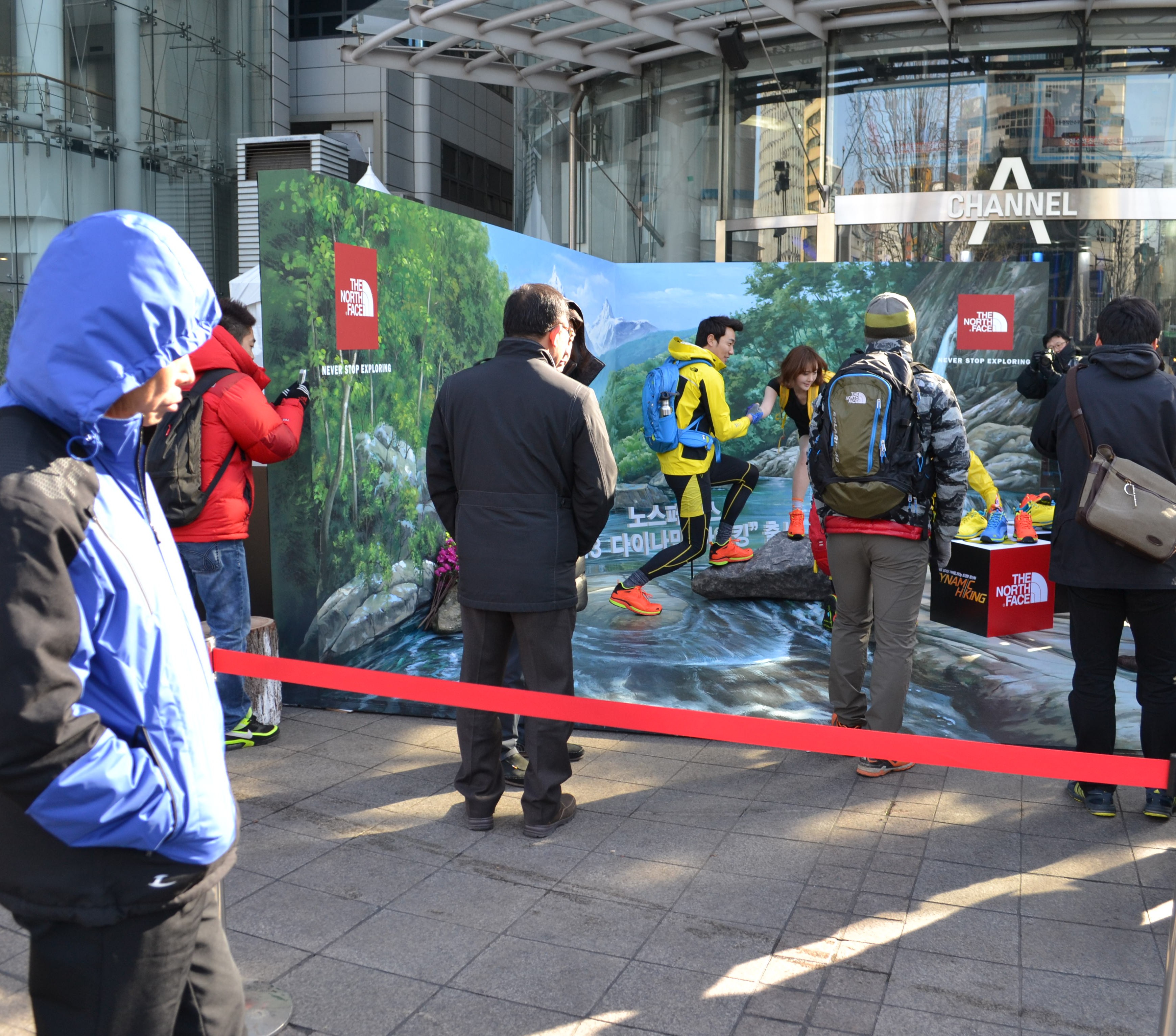
Models show off high-tech camping and climbing gear.
Today, Seoul is a mostly-affluent, sometimes futuristic city. You can swipe your RFID-enabled transit card to get on about a dozen subway lines that snake through the city, have your butt heated the whole way, and be right at home watching soap operas on your smartphone along with all the other passengers enjoying seamless 4G connections through the tunnels. When I first visited Cheonggyecheon, I wandered past a crowd of photographers gathered around a fake backdrop for a North Face photo shoot.
Now, said Park, was the time to think seriously about cleaning up air quality downtown and get carp and marsh snails back in the streams. Ecological health is a luxury for the rich, essentially.
It wasn’t the story I came for, and it wasn’t one I was comfortable with. But it was the honest perspective I found from both Park and the scientist, so it’s going to be the thread of my story. Sometimes, you have to be willing to toss out your well-prepared notes and follow your nose.


 Chris Chang-Yen Phillips: Storyteller and People Weaver