Why didn’t he just ride down 83rd Ave?

The thing I appreciate about Brideshead Revisited, Evelyn Waugh’s novel of man who gets entangled in a family’s downfall, is that it’s a tragedy in the truest sense: all the ingredients of the last act’s misery are plain from the very beginning. As soon as you see how desperate the main character is to wrap his legs around a life of wealth and charm and wit, you can tell things are likely to end darkly.

University of Alberta student Isaak Kornelsen’s death cycling down Whyte Ave this week was not inevitable. But if you bike at all in Edmonton, you can plainly see the ingredients there for tragedy.
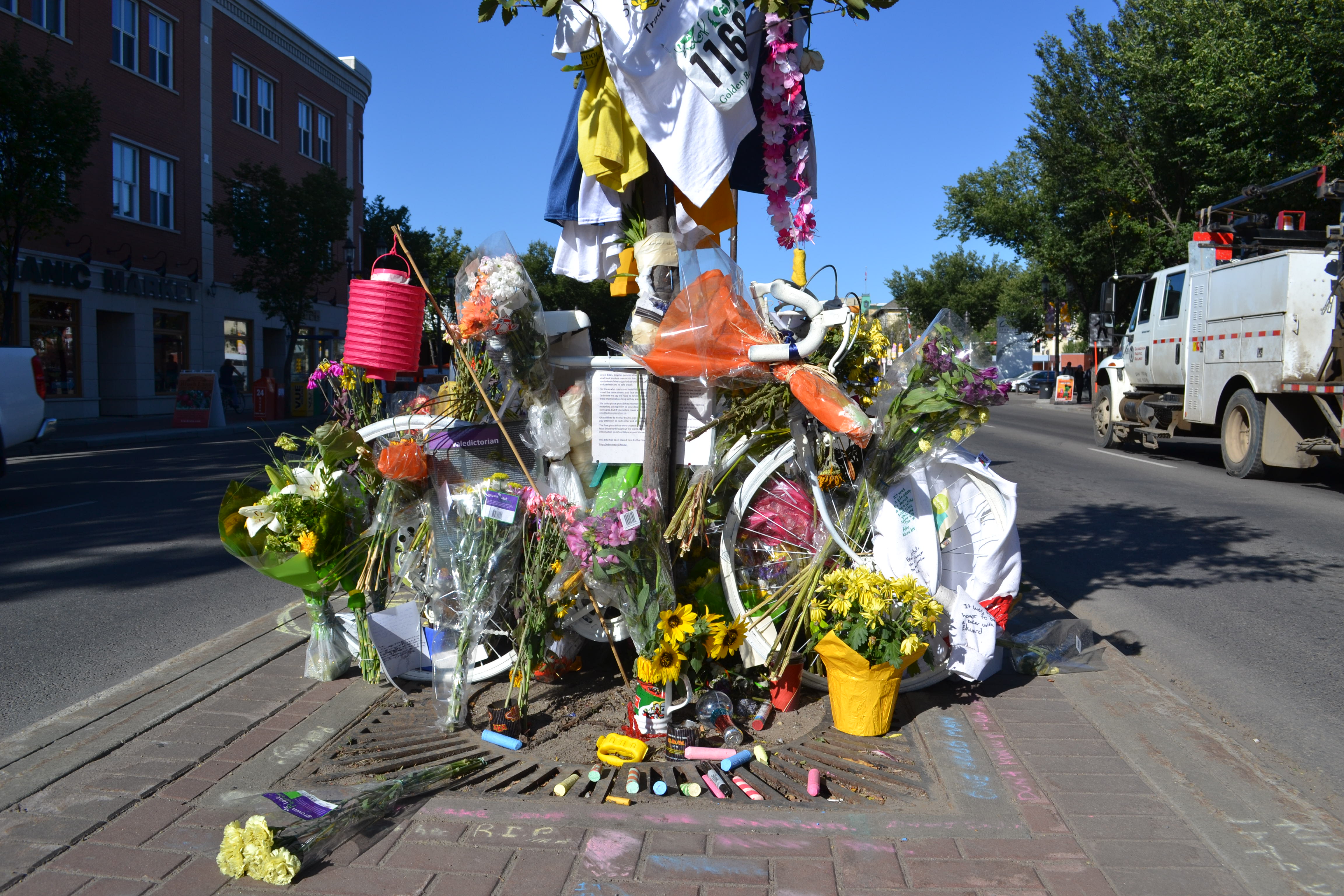
A white painted bicycle has been placed in a median on Whyte Ave. It is covered in flowers and cards for Isaak. A truck passes to the right.
A memorial set up by the Edmonton Bicycle Commuters for Isaak Kornelsen on Whyte Ave this week.

Isaak was riding his bike just a few blocks away from my house on August 27th. He was a cross-country and track athlete for the U of A Golden Bears, who’ve called him “a kind hearted and outstanding young man.” His family notes he was also passionate about his job serving and cooking at Café Mosaics on the other side of Whyte, and learning Swedish.

Whyte — or 82nd — Ave is mostly known these days for cupcake shops and nightclubs, but of course it’s also a major commuter road for cars, bikes, and huge vehicles trucking goods across the city. According to police, Isaak struck a mirror on a parked truck, lost control of his bike, and was crushed under a passing cement truck.

He was 21.

You might wonder why a cyclist would choose to bike anywhere with such heavy, dangerous traffic. I was on the bus the other day, and our driver was asking another passenger just that. As they shook their heads, the driver said, “Why didn’t he just ride down 83rd Ave? I feel bad for the driver.”

It doesn’t seem as if the cement truck driver intentionally struck Isaak, and in fact has said he didn’t even notice the bike had passed underneath him. But as soon as the bus driver asked this question, I felt like I could have guessed the answer.

Why didn’t he just ride down 83rd Ave? Because it would have made no sense to use 83rd. It’s a confusing, narrow road that starts out one way, was blocked off during the Fringe, makes it difficult to see traffic from other directions, and doesn’t even cross one of the major roads that are its bookends.

Why didn’t he just ride down 81st Ave? Because it’s blocked by a railway. Why not 84th? Another confusing road that’s partly one-way, blocked off by a parking lot. Why not 80th? You get the picture.

I commute through this neighbourhood regularly, and the only decent bike trails going the same direction are six blocks to the north or south, and both end just as abruptly as 83rd Avenue.

Bicycle infrastructure in Edmonton is getting better. The new bike corrals in Old Strathcona and the bike box intersection experiment will both make it safer and more convenient to get around. But by and large, traffic planning takes bikes into account as a distant afterthought. Patchwork bike routes that leave you staring at a set of train tracks push cyclists onto more dangerous roads that actually go somewhere.

Even more frustrating, there’s no reason Whyte Ave has to be this dangerous when trucks and bikes ride beside each other. As Edmonton Bicycle Commuters’ Chris Chan notes, “Collisions aren’t freak accidents. They’re the result of a series of decisions and events and the dynamics of traffic, taking place within a built environment and road design.”

Wide painted lanes for bikes, or separated bike paths, would make it safer and easier to get around. Some cities have even found fast, safe ways to clear bikes quickly from intersections without making roads any wider.

The most agonizing part of any tragedy is that its ingredients are visible from the start. Isaak Kornelsen did not have to die biking down Whyte Ave, but the factors that create dangerous situations like his are obvious. And they’re still there.

A Critical Mass bike ride in memory of Isaak will begin at City Hall on Friday, August 31st at 5:30 PM.

Our Shareable Neighbourhood

We were looking for a horseshoe.
Some of the folks out at last weekend’s Backyard Gardens walk.

I’ve had some time on my hands this summer to brew a couple new projects, and I think one of them is ready to open up a bit to the world. It’s called Shareable Neighbourhood.

Well, it wasn’t always called Shareable Neighbourhood. Technically this is the first time that’s ever happened. Initially I just called it Neighbourhood Walk, and between the two names you kind of get the idea: monthly tours of our neighbourhood in Old Strathcona/Mill Creek, to let people share what they know about local history and nature.

It was an idea born out of Next Up, the leadership program I finished this year. I’d been trying to dream up ways to get people jazzed about the nitty-gritty of where we live. Partly because I’m intensely curious about how and why things got to be the way they are, and partly because I think when you know more about what’s in your soil and who’s lived on it, you’re more likely to stand up for it. And partly I hoped that if we were all learning and sharing this stuff together more often, we’d feel like we had a more natural community of people to turn to when we need help getting a group solar panel discount, or bringing people out to a city council meeting — you get the idea.

The twist is that while we’ve had three so far and it’s ready to be murmured about online, it’s also young and needs fresh minds. I’m really trying to encourage folks in the neighbourhood to feel confident leading their own walks, even if they don’t have a degree or letters behind their name to qualify them in the idea. That’s why last weekend’s theme was Backyard Gardens: six of us who aren’t professional horticulturalists got to show off what we know about making tomatoes and delphiniums look good. So I want to decentralize the planning behind this as soon as possible, and we also need theme ideas.

So if you’re reading this, and you live in and/or know a lot about Edmonton’s Old Strathcona and Mill Creekish areas, drop me a line. If you have a tour you’d like to lead, great! We’ve done Plants of the River Valley and History of Immigration to Edmonton so far, and I think this month we’re going to investigate the local railways. And if you’d like to get involved in organizing, I’d love to hear from you too. Shareable Neighbourhood also has a Facebook group if you want to join. It might need to become a likeable page at some point.

By the way, this project owes a lot to the Jane’s Walks. They’re these annual walks all around the world that work exactly this way. Locals lead walks around topics like how an industrial heart became an urban park. I didn’t even realize how inspired I was by Tim McCaskell’s tour of Toronto’s gay village until someone pointed it out to me.

Also the name change was inspired by the great podcast 99% Invisible, which has much the same mission to explore the unseen story behind everyday parts of our lives. They tell beauteous stories about everything from how a picture gets on a stamp, to why US currency is so ugly, to how a Walt Whitman poem became wrought in an iron fence in Brooklyn. Just listening to the host, Roman Mars, this week made me more pumped about getting people to show off these unseen stories right beneath the surface of where we live. I highly recommend you check it out.

The Beavers That Lived in the Sky

This weekend I went to a farm in central Alberta for a gathering of Next Uppers from all over the province. I learned that the cattle farm was a bit of an Albertan punk rock institution not too many years ago, but more of the conversations drifted towards humans and our place in nature. Whether we have any place in it at all, in fact.

It inspired a little story I’d like to share with you, called The Beavers That Lived in the Sky.

A tower made out of sticks stands out in front of a bright blue sky
Photo credit: arvster

Once upon a time, deep in the forest there lived a colony of beavers. They loved to chomp down on trembling aspen trees, and build dams with them of course. Their dams created swampy reservoirs that lots of fish loved to swim in. The herons loved the dams too, because of all the delicious fish.

Gradually they spread into many colonies all throughout the forest, each with their own specialization: some built wider dams, some added tiny towers, some liked to decorate them with leaf sculptures, and some liked to carve famous beaver faces into them, like little Mt. Beavermores.

Then one day a beaver in one of these colonies said, Why should we stay in these little dams when we could build grand towers all the way up to the sky, high enough to see over the treetops? The other beavers in her colonies discussed this, and said it sounded like a very promising idea. So the chopped down some trees to build a magnificent tower, and lo and behold she was right, they had amazing views of the forest that no beaver had before.

The colony decided to become tower-makers and map-makers, creating exquisite maps of the forest from their new vantage point. And their maps were so splendid and renowned throughout the forest that they knew they’d struck upon the true destiny that all beavers were meant to fulfill.

With all these new trees they were chopping down, they could feed more beavers, and soon their first tower filled up and they had to build more to house everybody. The other colonies thought they were a bit strange with all their talk about the sky, but they said, “That’s all well and good for them, let them enjoy their big towers and we’ll keep doing what we’re doing.”

And they would have.

But the tower-makers started running out of trees. They pondered what to do. Then they looked at all the other places in the forest and said, “Look at those silly beavers mucking about on the ground. They’re letting all of their trees go to waste, and not using them to build towers at all.”

So they tried to convince the other colonies of the error of their ways. The other beavers said no thanks, but the tower-makers were adamant they knew best. So they started moving into the other beavers’ areas to launch mandatory tower-building masterclasses, workshops and conferences.

Where they found the others difficult to re-educate, the tower-makers were regrettably compelled to use force. With their huge numbers, the battles were short, and before long most of the other colonies had become tower-makers too. After a few generations, most forgot they’d ever made dams.

Unfortunately, within a few generations the forest also started to look a little bare. Actually it looked like a disaster zone. With so many mouths to feed, they were forced to build more and more towers, and chop down  more and more trees. Eventually most of the forest became barren clearcuts dotted with towers.

Some beavers started getting very concerned about the disappearance of the forest, and tried to tell others they were headed down a self-destructive path. They warned that unless things changed, there’d be no forest left at all.

The rest of the tower-makers looked around, and agreed they needed to harvest trees more sustainably. Some even agreed that a disaster was going on.

“But what can we do?” they said. “Would you rather live without maps and towers?”

“There’s not much we can do, to be honest,” they sighed. “This is just how beavers are.”