Act Out or Opt Out

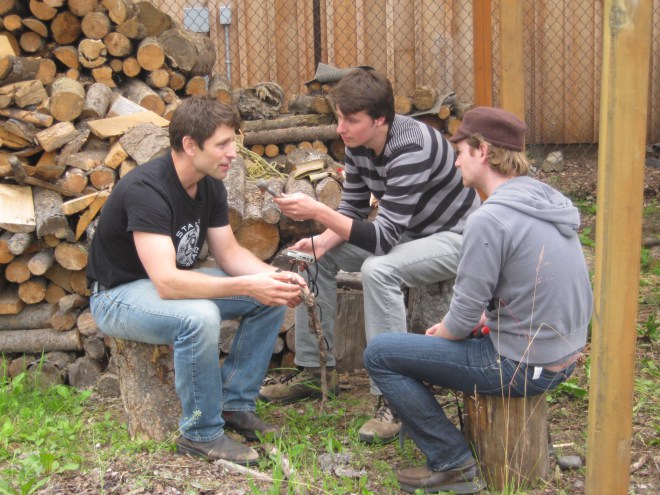
David Kaczan and Marcus Peterson (middle and right) were two of the Terra Informers who journeyed out to capture voices of locals along the Northern Gateway project route.

Every time I go to Calgary recently, people ask me what I think about the red skeletal swoops of the new Peace Bridge. I don’t have strong feelings about the bridge itself, but I was reminded of its pedestrian crossings this week when the Joint Review Panel decided to recommend building the Northern Gateway pipeline project.

Two years ago, I remember debating the objectivity of the Joint Review Panel process assessing the proposal to chug Alberta’s bitumen out to Kitimat. In early 2012, Terra Informa released a two-part radio documentary called Rough Waters & Divide Valleys: Voices from the Northern Gateway Pipeline. We sent a team of independent radio journalists out from Edmonton in the summer of 2011, and they travelled the route of the proposed pipeline, having conversations with locals along the way. I remember being surprised to hear how widely opinions diverged, especially in towns like Prince George where some talked about fearing for their forests, and others spoke plainly about hoping the pipeline would bring jobs to town.

What I also remember from discussions around that time is that many people in BC felt that the whole consultation process was rigged. Thousands of Canadians were fired up enough about the issue to apply to speak at the Joint Review Panel’s hearings. The Federal Government reacted by writing a new law to severely restrict how many people can have their say in future consultations.

It’s easy to see how this led to two main reactions among opponents of the project when the panel released their final conclusion that the proposal’s benefits outweigh its risks: complete apathy, and anger. This is where I’m reminded of Calgary’s Peace Bridge.

Say what you will about the aesthetics of the pedestrian crossing, or its cost, or how close it is to other bridges crossing the Bow River downtown (and Calgarians have said a lot about those things). What struck me when I first visited it is that when you cross over to its north side, you’re dropped off right onto Memorial Drive, with no obvious way to cross the four lanes of busy traffic to get to your destination. I watched for a while to see how other pedestrians reacted.
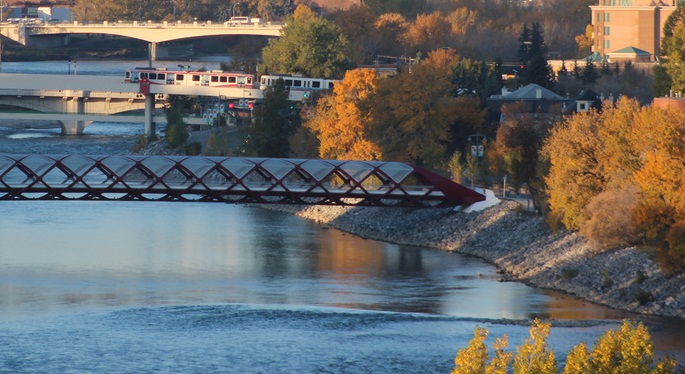
Shots of three bridges over the Bow River
My whole family assumes that I love the long red Peace Bridge, for some reason. (Photo: daveblogs007)

Most people looked earnestly for a safe place to cross, or a button to press. Then they saw how far away those were, and did the logical thing: they jay-walked. At no small peril to their lives, I might add!

It demonstrates a basic principle I heard outlined by a guest on CBC’s The House a while back: when people believe they have meaningful, fair choices, they’ll go along with one of them. When they feel like the choices are unfair, they’ll either act out or opt out. If you need to cross the street and the nearest crosswalk is unreasonably far away from your path, it’s understandable to act out and jog across the road. Not safe, but understandable.

The Joint Review Panel’s work was supposed to be an objective evaluation of the Northern Gateway project, weighing out the jobs, royalties, impact on local First Nations, risks to salmon-bearing rivers, risks of tanker spills, and adding it all up into one sober conclusion. But the Federal Government has been screaming its support for this project for years, passed a law limiting public participation in similar reviews in the future, and asked the National Energy Board to work with the RCMP and Canadian Security Intelligence Service to spy on environmental groups and First Nations participating in the public hearings. Under these circumstances, what reasonable person opposed to the project would believe it was a fair process? As ForestEthics Advocacy’s Amanda Follett says, it seems like the Panel wasn’t even at the same hearings as everybody else.

This is why you’re not likely to see many opponents shrugging their shoulders and saying, “Well, we did what we could.” BC First Nations, community activists, and environmental groups are gearing up for a fight if the Federal Government ends up approving the pipeline next year. When the game looks rigged, reasonable people will likely make the choice to act out or opt out.

If this thesis is right though, it offers hope to those fighting for genuinely participatory decision-making. When we see that our choices are meaningful, we’re more likely to jump in and help make them. That is something worth fighting for.
Gym is Cancelled

20131021-094955.jpg

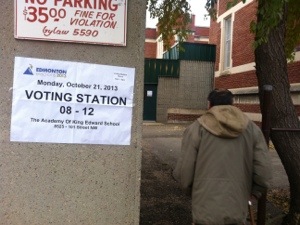
This morning I woke up early, packed my lunch, and strolled down to the old Academy at King Edward school a few minutes before 9. I went in through the side doors like always, and lined up behind a half-dozen seniors. An intercom buzzed somewhere behind us, announcing that gym class would be cancelled. It’s Election Day in Edmonton.

I don’t know why I love this ritual so much. I’ve been telling people for the past week I couldn’t bear to go to the advance polls. It’s like opening Christmas presents early, I said.

As the crowd started to multiply around the gym doors, a couple people tisked about being asked to wait, and I found myself getting territorial about my four square feet in line. “If they want us to vote,” one woman scoffed, “they should open at 8.”

Finally the elections staff pressed the doors aside and asked us to line up single file. As we inched forward from one line to another, I began to sympathise with the woman behind me, wondering why they didn’t just simplify things so she could rush off to her errands.

But somewhere between watching an elderly woman point her cane back and forth between the voting booths, the registration clerk overly annunciating the electoral oath, and colouring in little navy circles on my ballot, my eyes got watery and I remembered why I love this whole slow, sometimes-maddening, rarely-idiotproof day.

Just for a moment, all of us have something to say about who’s in charge, and damn it, we’re all going to fill out that scrap of paper come hell or high water.

Thanks for cancelling gym, King Edward.

Civic Election 2013: Taking a Special Interest

In April this year, an anonymous source leaked a grainy video of a closed-door meeting among some of Calgary’s real estate developers. A grainy video worthy of media attention should be enough to make anyone caught on film gulp, and in this case the footage made some Calgarians furious. Cal Wenzel, founder of Shane Homes, was rallying fellow housing developers to pour fountains of money into the upcoming municipal election to kick out anti-sprawl candidates on city council. I’ve been trying to untangle why this video has made some people incensed, while a slew of other special interest groups supporting candidates in Edmonton have become local celebrities.

Wenzel tells the audience in the leaked video that he and other developers had doled out $1.1 million in donations to the conservative Manning Centre and Manning Foundation in order to defeat city council members on “the dark side.” The Manning Centre’s new Municipal Governance Project is aiming to colour Canada’s municipal politics a little bluer by offering training and guidance to right-leaning candidates. At least five of this year’s Calgary city council candidates have received training through the program: Joe Magliocca, James Maxim, Sean Chu, Jordan Katz and Kevin Taylor, who also received transportation and signage help from Cal Wenzel.

At the time, Calgary Mayor Naheed Nenshi accused Wenzel of admitting that the developers and the Manning Centre had collaborated to severely overstep election finance rules. Individuals and organizations are only allowed to donate up to $5000 to a candidate in any year (no charges have been laid in this case, though).

While this wealthy group of developers may well be violating the spirit of the law, I wonder how much of the backlash (such a recent piece from David Climenhaga) has come from a feeling that this amount of influence is unfair, and how much has come from ideological opposition to the ideas.

This year, special interest groups have also stepped up in Edmonton to test candidates’ support for queer issues, sustainable urban agriculture, and arts and culture. Several have published the results of surveys they sent out to the candidates, including Yuri Wuensch’s highly-visible Vote Zombie Wall campaign – focused on keeping out the hordes by combatting sprawl. Wuensch has appeared at election events all over town with little controversy. So have the leaders of Activat ED, a youth-led group endorsing progressive candidates. And in fact, both of the latter appeared on my own radio show, Terra Informa.

Each of these groups has advanced a special interest by lending resources and limelight to candidates, or highlighting their credibility on certain issues. We have a word for that: civil society. Civil society groups, such as think tanks, churches, blogs and non-profits, carve out an important part of the public conversation outside of government and business. They’re a vital part of becoming informed and active in negotiating decisions in a democracy, whether we’re debating suburb growth or clandestine chickens.

It may be more productive to make sure that civil society groups are transparent in their activity, and accountable to our elections laws, than to try to shame them out of town.