
Everybody’s family is going to change

Poster for The Coming Out MonologuesLast week I had the pleasure of seeing The Coming Out Monologues at the U of A. Riffing off pieces like The Vagina Monologues and The Laramie Project, it was a play based entirely on the true stories of the people onstage coming out of the closet. I never get enough of these stories, and I loved their sincerity and vulnerability. Some of the performers were young, some were old, some had relatively painless transitions, and others ended decades-long relationships with straight partners. Most ended on something like a happy ending.

Except… a lot also ended saying something like, ‘It was tough getting people to accept who I really am, but things got better once they saw how normal I am too.” Which made me squirm. Is this the world we really want to make for ourselves?

I can attest that folks in the queer community spend a lot of time trying to be “normal” — as in, act straight. I do it all the time, often without even thinking about it. Is this underwear too gay to wear to the gym? Which part of the ceiling should I look at to avoid telling this group of guys I don’t like golf?

I remember bumping into an old drama teacher and her husband at a coffee shop when the Canadian government legalized same-sex marriage. They were telling me they couldn’t understand why it had taken so long for legal recognition, because it was so silly to think that two men being able to get married would affect everybody else’s relationship. Your marriage has no impact on ours, they reassured me.

But why shouldn’t it?

This kind of “normalizing” is a way of convincing ourselves that the Home Improvement, King of Queens, Everybody Loves Raymond-style straight, monogamous relationships in the mainstream essentially have it perfect, and that we can and should emulate them. More insidiously, it also implies that they have nothing to learn from us.
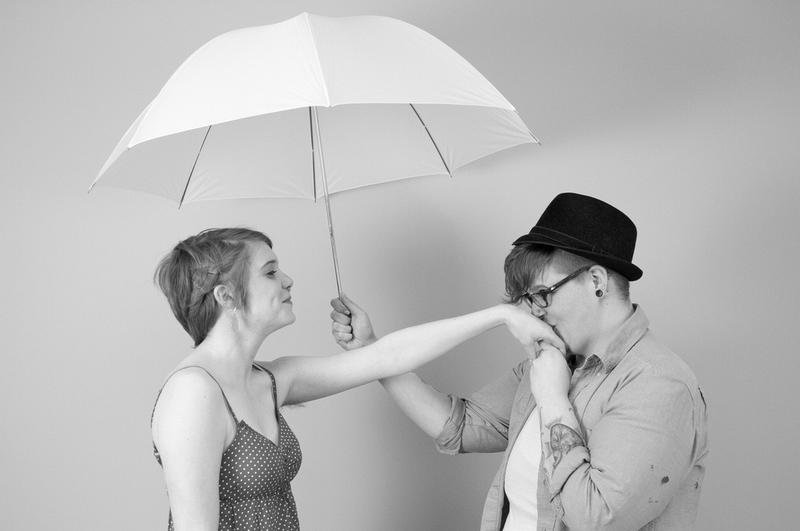
Claire holds her hand out daintily for a butch and wonderful Meagh to kiss.
My friends Claire and Meagh are irrepressibly cute. (Photo credit: Holly Norris)

I learn a lot from glances into my friends Meagh and Claire‘s relationship. I think they model a lot of things queer partners negotiate that most straight couples I know rarely think about. For an average hetero couple, how often do serious conversations come up about what it means that the man almost always drives? Not often, right?

But Meagh and Claire have had ongoing, loving talks about how they feel about their gender and their roles together. Is it okay to be a queer girl and wear lipstick and heels? Do my body parts match the way I feel inside? Do we want to use “she” all the time when we talk about each other? I don’t think Claire would mind me telling you she calls herself the feelings-top of the relationship.

It’s not fair to say that this happens in every queer relationship, because there are a near-infinite variety and queer folks are like the queens of experimentation. But because we don’t have many models of how they’re supposed to work, I think it’s fair to say it’s way more common to actively negotiate these things. Would it be the worst thing in the world for straight couples to learn something from this?

I’ve had second dates spent getting slurpees and analyzing the merits of monogamy and polygamy. For me, monogamy seems to offer more warmth and safety. But because so many gay couples try other things, the conversation comes up.

You may have seen those videos last year of a young man defending how well he was raised by his lesbian moms, and of a couple’s life through the eyes of one partner who’s only revealed to be a man too when he proposes at the very end. My friend Rosa did a brilliant dissection of the message those videos send. They’re both beautiful (and I’ve cried watching them for sure). She says, though…

The contradictory emotional state that each of them left me in was similar to that of an amateur drag show: delight, horror, inability to look away. But these videos were actually nothing like an amateur drag show; they were totally un-glittery; totally un-queer.

The young man is talking about his two moms to challenge the Iowa Senate’s bid to outlaw same-sex marriage by arguing that the sexual orientation of his parents “has had zero effect on the content of [his] character.” He seems like an upstanding and accomplished guy, for sure. But Rosa imagines writing him this in a letter:

Actually, it probably had a massive effect on the content of your character; you probably are smarter, stronger and more critical because of the sexual orientation of your parents. Because you realized that your moms and your family had to deal with a lot of discrimination, you probably have a greater sense of justice, a more open mind, a deeper political engagement. The audience should be applauding you for this, but not for a statement that perpetuates an idea that homosexuality is okay only if it is, well, just like heterosexuality.

I couldn’t agree with her more.

I want to learn from the people around me. I want to learn from the young parents across my street who just adopted. I want to learn from the family friends who’ve divorced and still take an active role in their kids’ lives. I want to learn from the people who try having two partners at once, even if it ends in tears. This is what we do. We learn from each other.

If you’re ready for an extremely not-safe-for-work blog, HOMO Online offers some brilliant tidbits about “seek[ing] communion with men like ourselves who reject heteronorms, queer-puritanism, airy-fairyism, consumerist-faggotry and the like.” They want to reclaim the closet, as an idea that queer men should carve out some spaces just for ourselves (including theirs online, which unapologetically features copious amounts of porn mixed with art and social commentary).

If you like Tim Taylor’s style of nuclear family, that’s okay, too. But can we agree that it’s a better thing to arrive at those decisions intentionally — and that straight folks might actually have something to learn from the pantheon of queer models too?

Alberta Election 2012 Underdogs: Meagen LaFave

Tomorrow is the big election, and I’m finishing this profile series with the ultimate underdog: Meagen LaFave, Wildrose candidate for Edmonton-Strathcona. She’s running for a party that’s climbed to the top of the provincial polls, but in a district that’s still very tough.

Seeing what makes a libertarian like LaFave want to run in a safe NDP riding was probably the most interesting experience I had working on this series. I talked to her about how her experience in health services affects her views on health care reform, what a libertarian thinks about recognizing rights for transgender Albertans, and why she chose Strathcona over any other part of the city.

Don’t forget to vote Monday, even if you’re not registered. If you’re in your home riding, all you need to do is bring government-issued ID to your polling station. The Council of Alberta University Students can tell you about the absurdities of forcing post-secondary students to vote from their permanent address.

The People’s Republic of Strathcona

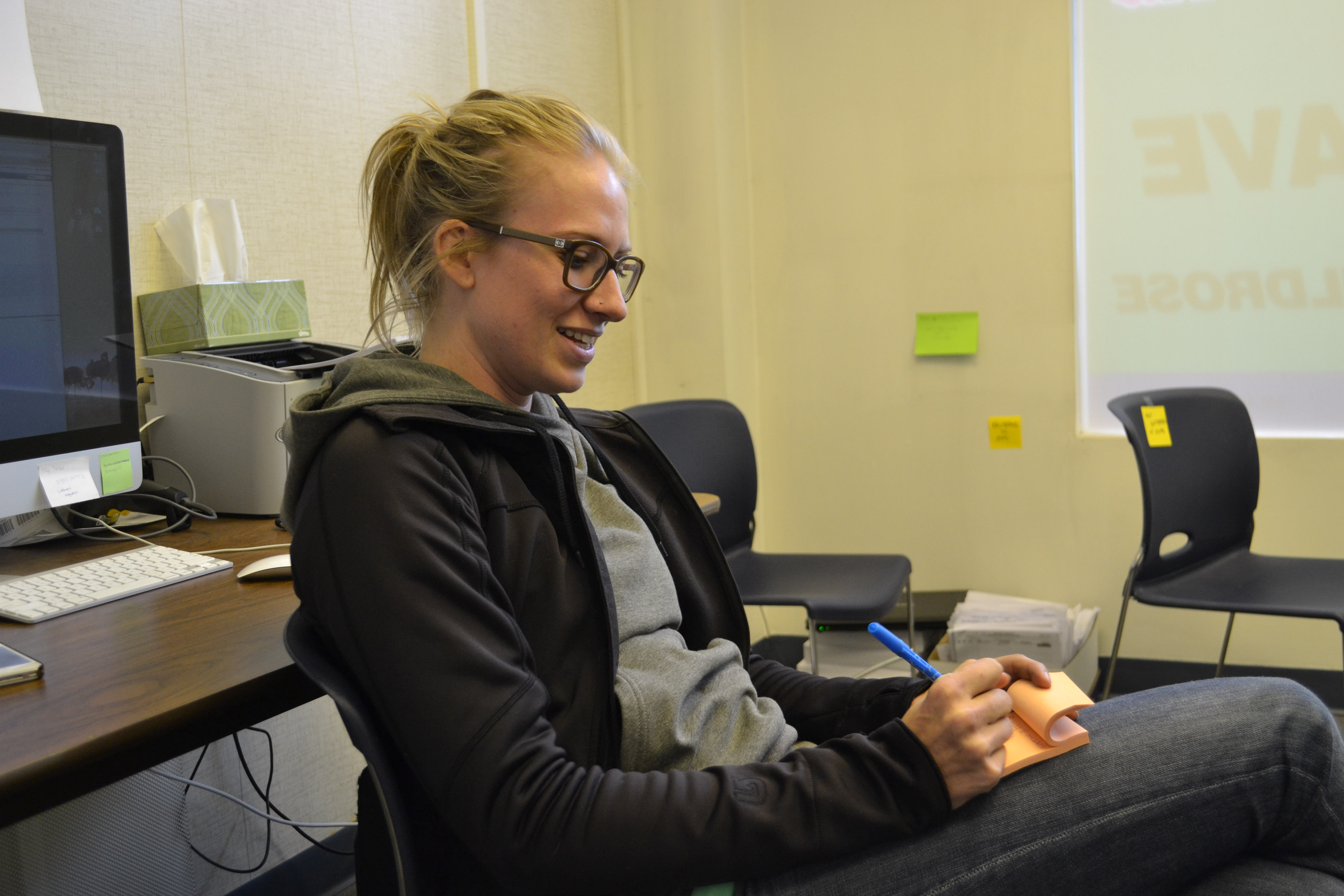
Wildrose candidate Meagen LaFave sits in her office writing on post-it notes
Meagen LaFave says she even writes "Sorry I missed you" post-its while she's watching TV these days.

As Meagen LaFave’s team watches a wind storm die down from her campaign office window, she coughs and finishes writing a stack of “Sorry I missed you” post-its. At 23, she’s the youngest Wildrose candidate in the province, and she’s still getting over a cold from pulling out all the stops campaigning.

On the wall, a whiteboard shows polling results from April 3rd. LaFave’s campaign manager tells me they stopped updating it once it got busy and they realized provincial numbers don’t mean much in what they wryly call the “People’s Republic of Strathcona.”

The NDP’s Rachel Notley is the current MLA for this riding, and their party has held it for most of the last 26 years. Notley’s predecessor Raj Pannu was popular enough to earn the nickname “Raj Against the Machine”. It doesn’t get much safer for the NDP in Alberta, but LaFave says Strathcona’s the part of the city that fits her best.

“I’ve lived in this riding, I love this riding,” she says. This is where she long-boards, shops, and watches theatre. It’s also where she works for a research group and bio-specimen business within the U of A.

There are a lot of conservatives in this area looking for an alternative, she says, and she thinks it helps that she’s a libertarian but not a hard-line social conservative.

LaFave says she couldn’t disagree more with Allan “lake of fire” Hunsperger about condemning gay relationships, for example. She believes it’s his right to say what he thinks, though.

Getting your hands dirty, starting work at 14

What made LaFave want to run, knowing the odds?

“I’m a pretty type-A person,” she says. “I went from being a bookkeeper to the business manager of my company.” So looking at the challenges, she figured if you’re going to get your hands dirty, you might as well get them really dirty.

“The libertarian values, frankly,” were what LaFave says attracted her to Wildrose. She had watched their development for years while studying political science and history at the U of A, and finally joined the party in 2011.

Like many Wildrose members, she used to be a PC supporter. Eventually stories of doctor intimidation, seemingly ever-increasing hospital wait times and accountability issues convinced her the party was broken. She didn’t expect Wildrose to take off so much, though.

Born and raised in Edmonton, LaFave says she has “quite a bit of blue collar” in her. She credits her entrepreneurial father and accountant mother with teaching her to be fiscally responsible. The day she turned 14, she started her first job.

The Wildrose Party has been criticized for fielding so many candidates like LaFave without experience holding public office. There are parallels to the flood of MPs elected in Quebec from the NDP just last year, many of whom were mocked at first but have proven to be capable politicians.

LaFave admits she doesn’t follow federal politics much, but thinks she has weight from her work experience, and is privileged to see dysfunction in our health care system through her work with Alberta Health Services and the U of A.

“Everybody getting involved in politics starts from ground zero.”

The relief valve of more private health care

Two green Wildrose T-shirts sit on top of a stack of Edmonton Senior papers.
Beneath the Wildrose T-shirts, LaFave's office keeps a stack of the Edmonton Senior papers where they bought an ad.

Health care questions are definitely LaFave’s favourite to answer at the door. One woman she meets is encouraged by Wildrose’s promise to increase funding for home care, but wary of a two-tier system emerging. LaFave emphasises that they’re only proposing publicly funding more private delivery if a wait-time guarantee isn’t met.

“But what happens when that door opens?” the woman asks.

It’s a question LaFave doesn’t mind answering. Her experiences working with Alberta Health Services have made her adamant that big changes need to be made to the province’s health care system.

There’s a huge amount of waste in the bureaucracy, she says. Because her company is a not a for-profit entity connected to AHS and the University, it has to pay a large chunk of any funding it gets directly to their joint research centre NACTRC. LaFave says over the years NACTRC has stopped providing even basic clinic space in exchange for that money, and concludes the money is now just boosting bureaucrats’ salaries.

I ask LaFave why not spend her energy reforming the bureaucracy within the public system if she has these insights. There’s a lot of evidence that private delivery of health care is more expensive than public delivery. For example, Canadian Doctors for Medicare has published a report showing the “pac man” analogy of health care continually eating up more of provincial budgets is mostly due to shrinking revenues and rising costs of private services like drug and dental insurance.

LaFave also works directly with billing, so I point out that a lot of research shows the exorbitant costs of the US system are partly pushed up by the amount of private health care providers they have trying to untangle a web of who pays for which patients to use what services (This American Life has a great special called More is Less that explains this in more detail).

LaFave is firm that she sees so many superfluous people working in health care billing in Alberta that cutting their jobs would balance that out. And the wait-time guarantee would just be a relief valve, she says, until more front-line doctors and nurses are hired.

What seems fuzzy is how a Wildrose government would gauge when they cross that finish line.

Those contentious moral issues

Even in the People’s Republic, the Wildrose name gets a lot of people excited about change. One man wants to meet LaFave at the door just to tell her, “We need new leadership. Big time.”

But she tells me that questions about homophobia, racism and other bigotry among Wildrose candidates have outgrown most of the policy questions people pose.

“My opinions are not the same [as those views],” she says. “That’s where the libertarian thing fits me so well.”

So I ask her what the libertarian response would be if a gay constituent said a marriage commissioner had denied their right to that public service, by declaring it violated their conscience rights. She pauses.

“I haven’t really considered whether someone should be forced to offer marriage,” LaFave answers honestly, “because I wouldn’t want to force someone to do something they disagree with.”

It’s an obvious tension in her desire to champion individual rights, and she doesn’t have an answer yet on how to negotiate them when they compete. She’d probably want to help both sides resolve the issue through the courts, she says.

Finally, I ask Lafave about the Wildrose pledge not to legislate on contentious moral issues. This has mostly been framed as a way to reassure voters they won’t try to do something like de-list abortion. The flip side is it implies they won’t work on expanding legal protections for groups like trans people.

A transgender rights bill is working its way through the House of Commons yet again. This attempt to explicitly protect people from being denied things like housing, employment, and health care because of differences in gender identity and expression has been killed so many times that its old sponsor has actually retired from Parliament. With Albertans like teacher Jan Buterman lack legal protection when they’re fired for how they express their gender, it’s a serious issue that could be addressed provincially.

LaFave admits Wildrose’s pledge means they wouldn’t bring any such legislation forward. That doesn’t mean she wouldn’t raise the issue with her caucus if constituents told her it mattered.

“As a representative for Strathcona,” she explains, “if people said it’s something they want me to bring forward, that’s my job.”

“A libertarian wants people to do what they want to do, and work where they want to work.”

***

Meagan LaFave’s campaign website

Alberta Election 2012 Underdogs: Akash Khokhar

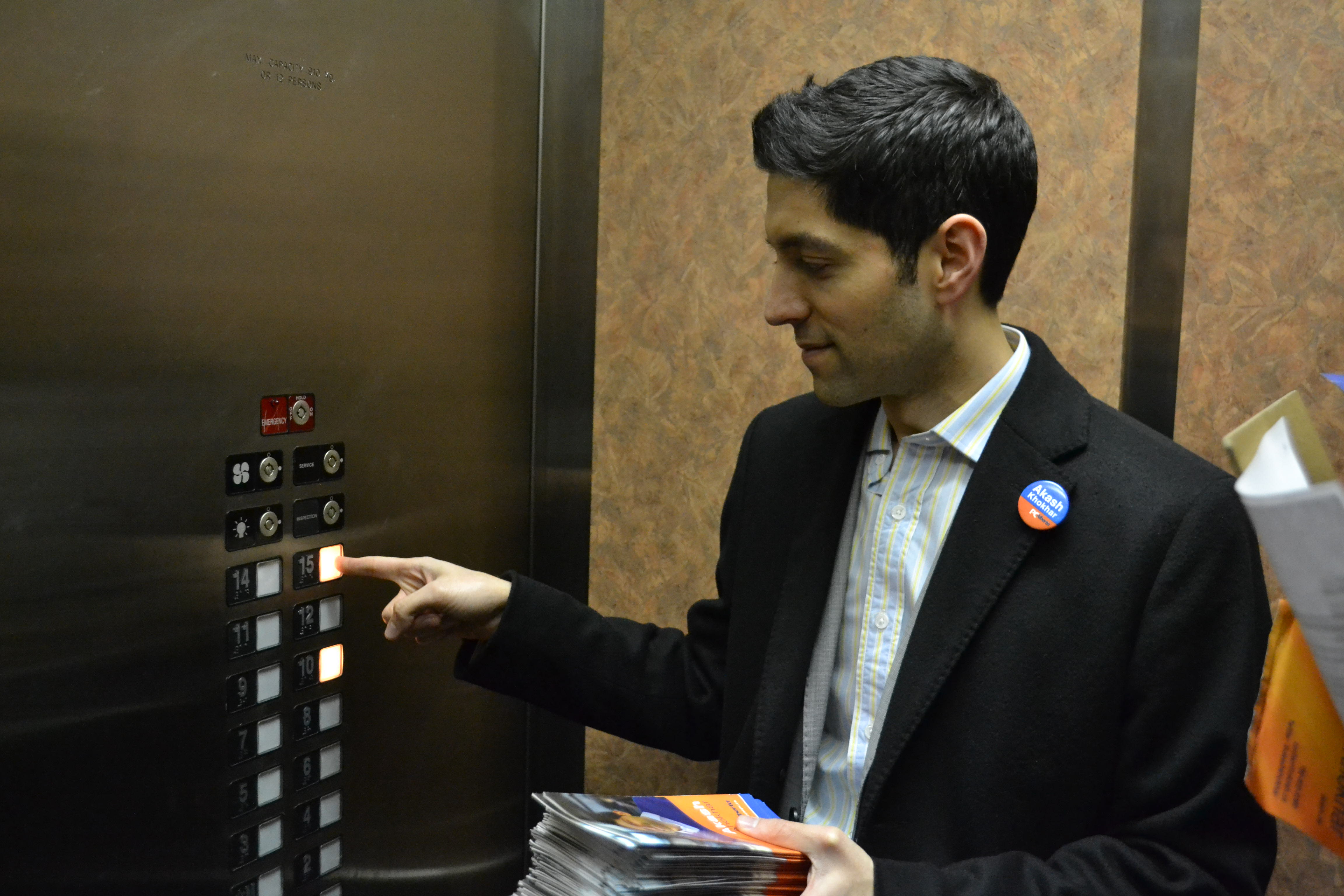
Akash Khokhar presses the elevator buttons in a downtown apartment building
The number of apartment buildings in Edmonton-Centre makes getting in to campaign a bit of a challenge.

In today’s underdog profile, it’s time to meet Akash Khokhar. He’s the PC candidate for Edmonton-Centre, held by Liberal MLA Laurie Blakeman for 15 years now. When you see those PC ads that say “Not your father’s PC Party,” Khokhar is the guy they want you to think about.

Just look at the cute self-deprecating video his team made to help people pronounce his name. It’s an idea cribbed from Naheed Nenshi, who hired the same campaign strategist for his mayoral run as now-Premier Alison Redford. Khokhar shares more than a meme with Nenshi. He has a similar belief that Alberta’s leaders need to embrace its growing diversity.

Alison Redford, he thinks, is the leader who best embodies the ways the province needs to change. I asked Khokhar how her leadership win influenced his decision to run, what it’s like bumping up against four decades of his party’s reputation, and how he hopes to unseat a queer-friendly MLA in a riding that scoops up Edmonton’s gaybourhood.

The model progressive conservative

Campaigning in a dense downtown riding has its challenges — starting with getting inside buildings to see the voters. Waiting in the lobby of one older adult residence, Khokhar is finding it difficult to convince the building manager he’s willing to risk interrupting people while they’re having dinner.

Finally, he leans into the intercom and calmly states, “Sir, you are aware that under the Elections Act you are required to let us in.”

The door buzzes and we walk inside.

A lawyer specializing in insolvency cases, Khokhar can be firm. But he’s also the kind of person who’s met voters twice in one day: once while door-knocking, and once while delivering Meals on Wheels. He’s the co-owner of Suede Lounge on Jasper Ave, and he does pro-bono work on eviction issues through the Edmonton Community Legal Centre. In other words, he’s out there in the community.

After studying international relations in California and doing a law degree at the University of Toronto, Khokhar came back with some clear ideas about the strengths of diverse cities.

Khokhar’s ideas seem to fit the bill of a model “progressive conservative”: the way we run our communities and our province is basically fine, it just needs some tweaks to provide better business and social supports.

For example, I ask him what he’s learned from working for people facing evictions. Legislation for tenants is pretty good, he says. The big problem is access to justice. He thinks more dispute resolution mechanisms would help ease the burden on the courts and are less intimidating and pricy for poorer people.

“Everything I went to law school to do, she had done.”

It’s easy to see why Khokhar was lured into running by Alison Redford’s party leadership election last year. Her turn towards the Joe Clark-style progressive wing of the PCs is palpable enough that it’s fuelled the membership exodus bleeding supporters further right to Wildrose.

“Everything I went to law school to do, she had done,” he says. Redford had worked as a human rights lawyer, worked with Nelson Mandela, and come back to become Justice Minister and Premier.

“Her being elected showed a real shift to me and a recognition that the province is changing.”

On social and fiscal issues, she just seemed to be a fit for him that came out of nowhere. It was enough to persuade him to run for office for the first time.

On fiscal issues, he says he supports Redford’s plan for results-based budgeting (re-examining the value of all department spending from zero up, rather than looking for simple cuts or additions to what’s there). Having seen government from the inside working for Intergovernmental and International Relations, he says it’ll help identify inefficiencies and stop budget inertia.

“I think my job could have been done by someone who was already there,” he offers, laughing.

Of course, the timeline of Redford’s influence as leader means he was only nominated in January. He’s been campaigning hard since then, but three months of groundwork puts him far behind the incumbent Blakeman’s name recognition.

Wearing 41 years of other people’s decisions

What does get a lot of recognition is the PC name. It’s hard to imagine joining the party at a worse time for a new candidate. Khokhar points out that about half of their candidates are running for the first time, but they’re facing the reputation of 41 years of PC rule. That’s a lot of other people’s decisions to wear for a rookie.

At one apartment we come to, for example, the man at the door says his biggest problem right now is with the federal government, and getting disability support. Khokhar points out that Redford has only been premier for six months but has already raised AISH, an income-support program for people with disabilities.

“Too little too late,” the man says.

Khokhar may be new, but it’s inevitable he faces tough questions for his party’s decisions from the left and the right. One man speaks to him entirely in French (and Khokhar plays along gamely) until he’s had a chance to point out Tory flaws in providing arts funding and affordable housing for 50+ year olds.

Another says he’s a PC supporter, but works for Enbridge and worries whether Redford will push hard enough for the Northern Gateway pipeline. A seasoned campaigner walking with us interjects that she’s been fighting hard for its approval.

This too reflects the legacy Khokhar is working with. Most of his campaign team are young faces, but this shmoozy campaigner is a senior policy advisor, and has been working for the PCs for decades. It seems like second nature to him to lean over and suggest notes I should be taking from a speech he makes on arts funding.

How much can a party with so many insiders left change from an institutional culture that’s been battered by years of scandals over entitlement and corruption?

Not your father’s PC on queer issues

Khokhar himself isn’t boxed into Klein-era ideas, and it comes out (pardon the pun) when I grill him about queer issues. Having lived in Oliver myself before, I ask him how he thinks he would represent an area with Alberta’s most prominent gaybourhood better than Blakeman.

The first time I met Khokhar was actually at Suede, when they were hosting an event for the leaders’ debate. At that time, he seemed vague about his thoughts on Bill 44’s rules on teaching material related to religion, sexuality, and sexual orientation in schools. He frowned and said Blakeman didn’t have a monopoly on supporting minority rights.

Still, he hadn’t even heard of the government’s decision a few years ago to cut funding for gender reassignment surgery. GRS can be crushingly expensive, and it’s a serious issue for transgender folks who need to make a physical transition.

But by the time I sat down with Khokhar in his office, he’d asked Redford about it, and gotten a commitment that the funding would be re-instated.

“I think that’s right,” he says.

“I’m not running because of what the party was, I’m running because I believe in what she stands for.”

***

Akash Khokhar’s campaign website

This weekend: the final underdog profile. I’ll be talking to Meagen LaFave, the Wildrose candidate in Edmonton-Strathcona.