The Terra Informa team from our CJSR FunDrive show in 2013.
I’m about to take a big move. After two years working at the Alberta Council for Global Cooperation, I’ve decided to take a leap into a job in radio. This month I will become the News Coordinator at CJSR 88.5 FM, the Edmonton community radio station where I’ve been working on Terra Informa.
I love my team at Terra Informa. It embodies many of the best things I like about storytelling and volunteering. Our team is willing to take risks, like traipsing around in the snow and rattling the fence outside a planetarium after dark to narrate a whole episode about night. Everybody genuinely cares about each other, and recording together always feels like friends sitting down to have a good conversation. Now I’m going to be managing the current and new rosters of volunteer contributors for all of CJSR’s Spoken Word shows, from our queer community anchor GayWire to University of Alberta partnerships like The Gateway Presents.
I’m really excited to have the opportunity to work with CJSR’s impressive base of volunteers and community supporters and build on our legacy of independent, award-winning spoken word programming that challenges the status quo. My predecessor Matt Hirji has a gigantic mural of Ira Glass on his wall, good-naturedly watching out, eyes clearly curious and hungry as all get out. Ira will be hovering over me too on my new journey. Wish me luck.
This spring, I’ve had the chance to peek into what life without ID looks like in Canada, interview one of Canada’s most interesting authorities on environmental policy, and produce the most music-centred story I’ve ever done for Terra Informa.
A close-up look of the stone harp that Páll invented.
First off, the story I made for the many people who asked to hear the recordings I made of artist Páll Guðmundsson while I was in Iceland. This story was a mix of liquid luck and preparation that paid off. If ferry workers hadn’t been striking in south Iceland where we originally wanted to go, our friends at the tourist bureau in Reykjavík would never have recommended we go check out Páll’s rock sculptures in his tiny summer village of Húsafell. Fortunately I had packed my pocket-sized Zoom audio recorder just in case I met someone life changing, whose story I absolutely needed to tell.
Have you ever gone somewhere new and had the feeling that you’ve been there before? Imagine going away on a trip and finding that everything you see reminds you of home: the stores have the same shape and sell the same clothes, the restaurants serve the same sort of food, the people listen to the same kind of music…
What about somewhere embraces its own character and qualities? That’s what I saw in Páll Guðmundsson, an artist whose local and naturally inspired work makes his home feel one-of-a-kind. Listen from about 10:18:
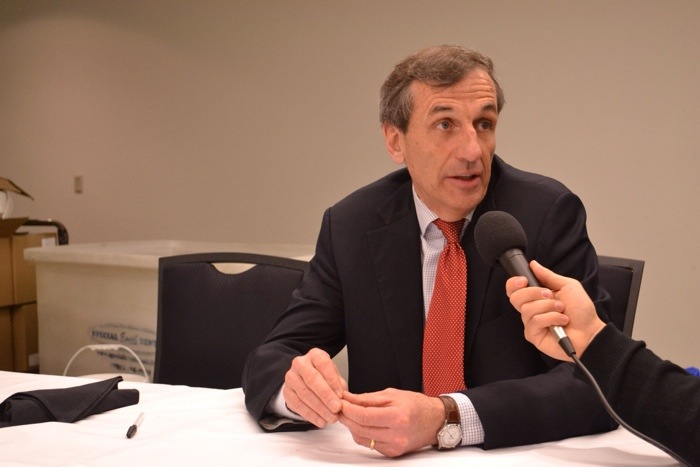
Scott Vaughan, plus my hand.
Next, my interview with Scott Vaughan, Canada’s former Environment Commissioner and the new President and CEO of the International Institute for Sustainable Development (IISD). IISD just took a big leap forward for themselves, and for aquatic science in Canada, by successfully negotiating to become the new operator of the Experimental Lakes Area in northern Ontario. It’s one of Canada’s most important (and most famous) scientific research facilities.
There, scientists have a unique ability to conduct experiments on entire lake ecosystems — in some cases, their research lasts over decades. The research there has caused major changes in the way we live in Canada: like how acid rain affects freshwater fish, and how phosphates in our detergents can cause algae blooms.
But in 2013, the federal government said it felt the Experimental Lakes Area’s research was no longer necessary, and to be be shut down. That set off a mad scramble from environmental groups, activists, and researchers around the world to find a way to keep it alive.
I got a chance to meet Scott Vaughan at the Zero 2014 sustainability conference in Edmonton to discuss how the year of upheaval will affect the research at the ELA, and what he learned about the federal government’s attitude towards research during his time as Canada’s Commissioner of Environment and Sustainable Development. We had a frank talk about whether he and the other parliamentary officers who’ve irritated the government ever get together and commiserate, but regrettably I had to cut it out of this Terra Informa story. The rest still makes for a fascinating story, I think. Listen from about 1:28:
Finally, this week I finally got a story out that I’ve had in my head for a long time. Last year, I noticed a flyer up in the Stanley A Milner library in downtown Edmonton, advertising an ID storage service at Boyle Street Community Services. I was intensely curious why anyone would need to have the centre lock their ID away. It led me down a rabbit hole of the frustrations that face seniors, homeless people, the recently-incarcerated, anyone who wasn’t born in Canada, and ultimately, our democracy.
On the advice of my mentor, I am sharing more small updates about what I’m working on. In the past couple of weeks, my thoughts and stories have been with a remarkably caring family on the streets, and with a bird desperately in need of friends in Alberta.
My story for the CJSR Homelessness Marathon was quite a challenge to put together. I can’t remember ever before spending a whole afternoon recording hours of tape, then whittling it down to a 20-minute mini-doc for radio. In this case, we had many months of time to prepare for the national marathon of community radio programming about homelessness in Canada. I used some of that time to get to know the people on the Boyle Street Community Services winter outreach van, which roams all over the city offering people a chance to warm up, get some hot food and supplies, and share the company of people who care about them. I discovered that it isn’t just people on the streets who benefit from this van’s work, though. Together with the staff, they make a caring family that feels it deeply when one of their own is lost:
This week on Terra Informa, my friend Danielle Dolgoy and I chased down a story about one of Alberta’s most threatened species. University of Alberta researcher Mark Boyce estimates that over the past few decades, the number of greater sage-grouse in the province has dipped from the thousands to a few dozen. There are so many reasons this is happening – oil and gas development, farming pressures, hawk predation… millions of reasons why the federal government sat on the sidelines for so long before issuing a special protection order under the Species At Risk Act to dramatically protect the bird. We were curious to know what finally motivated some of the parties involved to see what’s in it for them to protect the greater sage-grouse:
I’m headed to Iceland soon, and will be back near the end of March with some good stories about the archetypal land of Ice and Fire.


 Chris Chang-Yen Phillips: Storyteller and People Weaver