6 Thoughts About Speaking Up

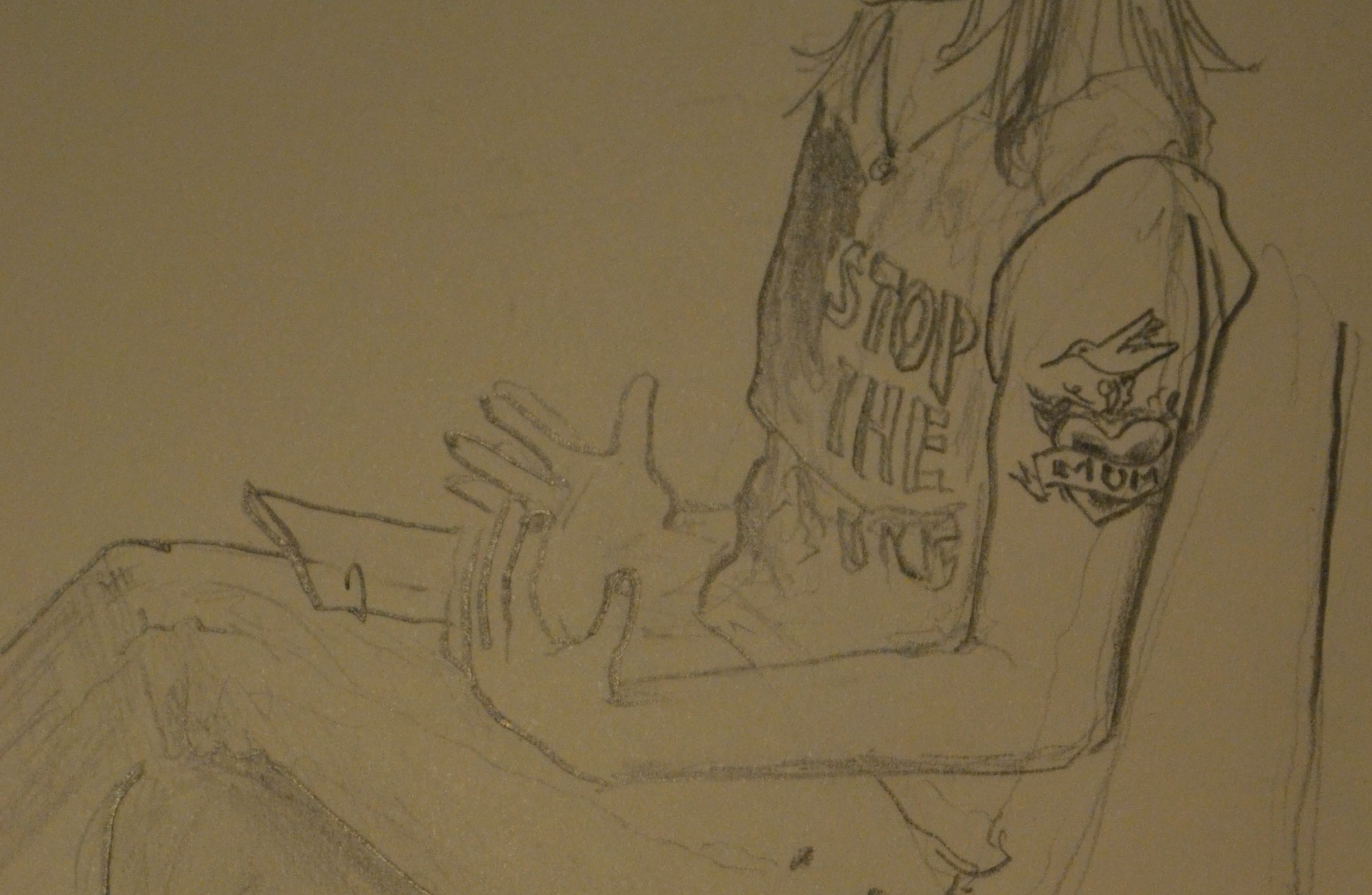
A sketch I made at Annie's Share-back.
This sketch of Annie Banks I made at her “share-back” event unintentionally captures her mixture of toughness and gentleness.

What if we speak?

It was a question some of my friends asked last winter, when the Idle No More movement lurched into the public eye: what if we, as people from white settler and immigrant communities, speak up and say we also want justice for Indigenous people in Canada? It became a book of poems and reflections that my friend and radio colleague Annie Banks contributed to, with the same name. More recently, she came to Edmonton to share stories about her efforts to learn when to be noisy, and when to be quiet.

I first met Annie at a documentary launch party that Terra Informa held last spring. She was new in town and eager to leap into a group of people telling stories about how environmental issues affected ordinary people, and what they were doing about it. We were all convinced by her gusto that she’d lived here for ages. She challenged us with new ideas, like her practice of naming the Indigenous territories where each of her stories took place.

Then she left us for San Francisco, on what I know she would want me to acknowledge are Ohlone and Chochenyo territories. She spent the early part of this year in a program called the Anne Braden Anti-Racist Training for White Social Justice Activists, and wrestled with some hard questions about herself and her work that I think are worth sharing.
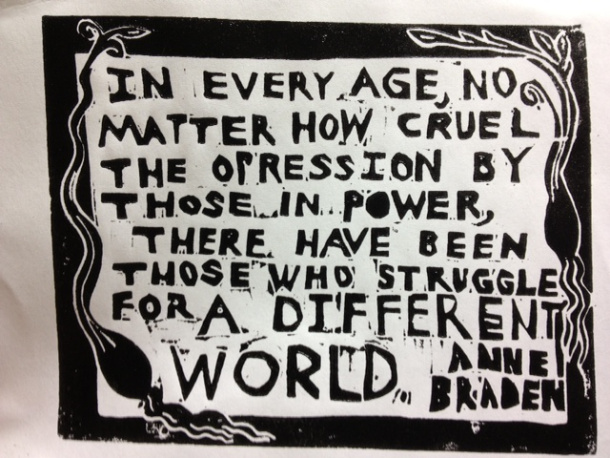
A linocut of Annie's.
A linocut of Annie’s.

They’re relevant for many contexts, but especially pertinent because we still live in a culture where white people have a disproportionate share of power: where Aboriginal and black people make up more than their fair share of people in prison, Indigenous people all around the country are fighting to maintain control over what happens on their land, and our federal government’s campaign to demonize refugees in need of health care is likely to convince more of us that immigrants and refugees are “enemies at the gate.” These are problems that will need all of our participation to resolve.

Here are some of the things I’ve gleaned from Annie:

1. Lean in. Listen closely, and see where people are at before lecturing.

2. Make your space affirming. If you’re in a group of people organizing something important together, make it a joyful and enjoyable experience. She said this one was hard for her, because she’d always felt like heavy subjects demanded a sombre atmosphere.

3. Be patient. This is something of a rhyme to the title of her blog, Noisy and Quiet. For her, being an ally in a movement led by traditionally marginalized people means giving up some of the assumed power in that environment, and recognizing the pace your allies need to follow. Annie interned with the California Coalition for Women Prisoners, and it she said this was most clearly demonstrated when the group sometimes needed to wait for letters to go back and forth to people inside, which could take months.

4. Recognize that self-love makes a strong foundation for your work. I know this one was tough for her too – to hold all the knowledge about racism today in one hand, and still have some grounding and love for her white roots.

5. Don’t step back so far you disappear. Annie told a funny story about overcoming her feelings of anxiety about taking up too much power and space in a movement, as a white person. Someone came up to her, apparently, and reminded her that the group still needed her to be useful and get dirty. To do that, she said, she needed to acknowledge that sometimes she’d make mistakes, and mess up, and that’s okay.

6. Think about how to leverage your privileges for others. Annie spent a long time, even when she arrived in San Francisco, feeling uncomfortable about being able to attend this program all the way in California when others didn’t have her privileges: family members to help her pay for it, US citizenship that allowed her to get a job, and a friend to literally drive her all the way there. But in the end, she was persuaded that she could take her experiences and knowledge from the Anne Braden program, and share it back to people back home.

Which is what brought her to the Edmonton “share-back” that I attended, and which makes me so proud to be her friend and occasional student. Thanks, Annie.
What trade can’t do

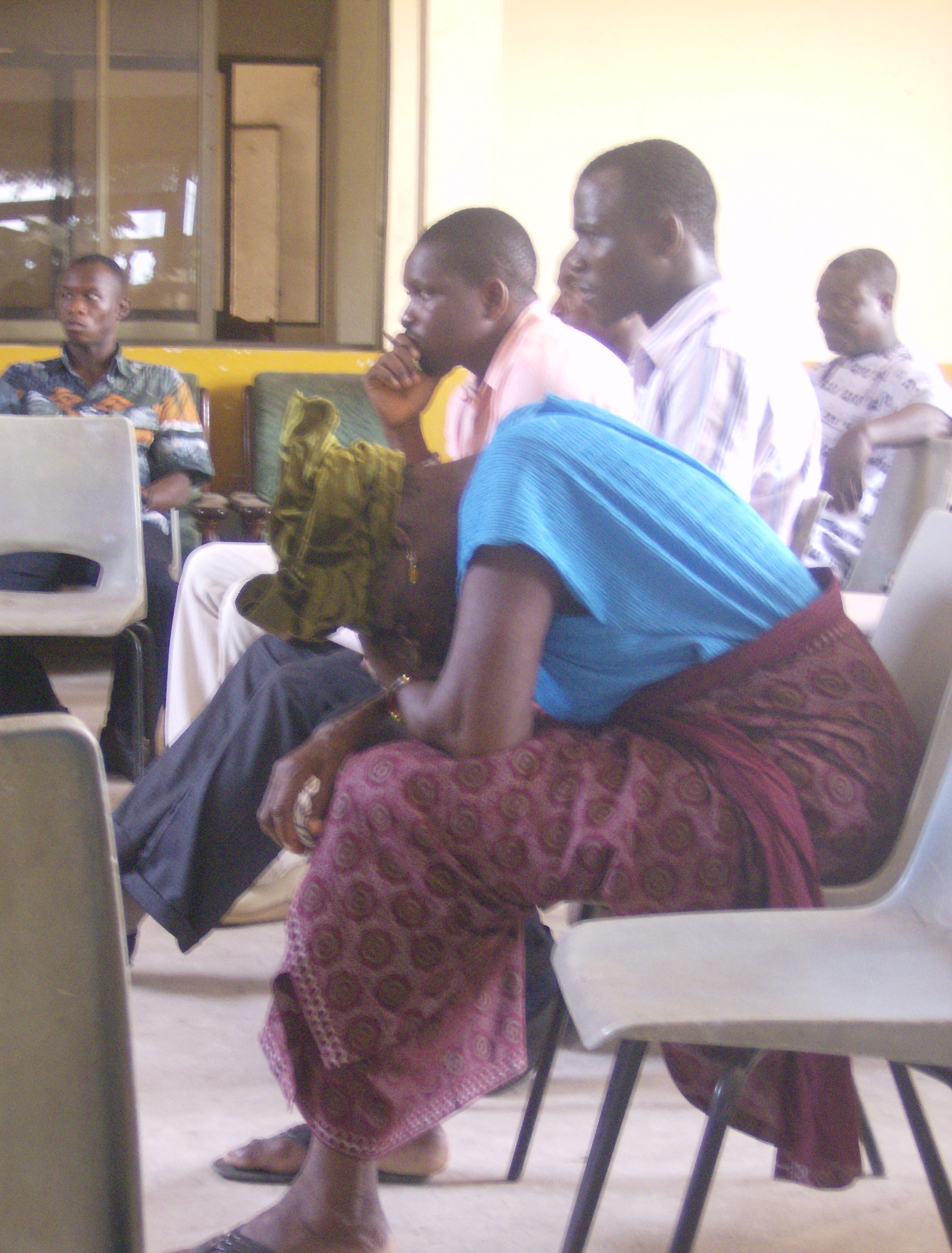
As this woman experienced at a rights-based development workshop in Tema, Ghana, development work can be tiring and frustrating. But that's not the whole picture.
As this woman experienced at a rights-based development workshop in Tema, Ghana, development work can be tiring and frustrating. But that’s not the whole picture.

Since it’s my job these days to defend the interests of organizations that do development work, I’ve tended to silo off that part of my brain from the part of me that gets irate at home and writes about things. But this Globe and Mail editorial is so brashly ignorant that it demands a reply. It attempts to defend the merger of CIDA and Canada’s Department of Foreign Affairs and International Trade by arguing that development projects have never done anything that trade couldn’t do:

Impressive strides in poverty reduction have been made in the past 15 years in countries such as Brazil, South Africa, China, Mexico, Nigeria and others in the developing world. There are 800 million fewer people living in poverty today than there were in 1990. Some of the emerging economies are growing at a faster rate than Canada’s. The proportion of people who lack dependable access to good sources of drinking water has been halved – two years ahead of the time frame set out in the Millennium Development Goals.

There is no evidence, however, that this dramatic improvement in living standards is the result of international development assistance. Instead, these changes can be attributed mainly to trade liberalization, gains in productivity, technology and national income redistribution programs – and even to remittances from immigrants in the developed economies.

Now, it’s true that civil society organizations that wade into development work often focus on small projects and shy away from entering political debates, where uncomfortable conversations about immigration, labour laws, and land redistribution would have bigger impacts on people’s lives. CIDA has certainly been guilty of putting on these blinders. But it’s simply ignorant to argue that everything development work does could be done better by cracking countries open to global markets.

Trade liberalization doesn’t organize people to claim and manage their constitutional rights to water, land, clean air, or a place to live. Mining conglomerates, as a rule, don’t push for (and try to improve) school feeding programs that purchase food locally to support the small-scale farmers sending their kids to those schools instead of industrial corn growers in Iowa. Hedge funds buying up land to make a quick buck don’t stick around in a community after the water has gone and the work has dried up to see that climate change is destroying a community’s livelihood, then get out on the streets demanding climate justice.

NGOs, church groups, advocacy groups, and even the terribly frightening academics who study development occupy a niche that Barrick Gold, Ministers of International Trade, and venture capitalists wouldn’t want to enter even if they had the credibility to do so.

To the end, my dear

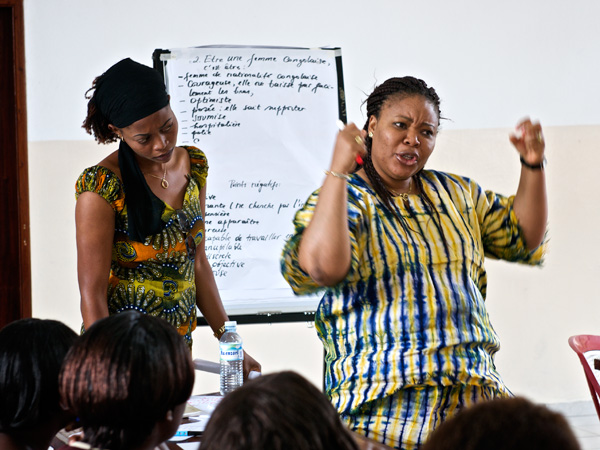
Nobel Peace Prize winner Leymah Gbowee stands in front of a white board with her hands raised like she's trying to push the crowd into action.
Nobel Peace Prize Laureate Leymah Gbowee confided that Archbishop Desmond Tutu warned her to watch her words carefully after winning, since they’d instantly be published on the internet (Photo by Alissa Everett)

Last night, my friend Evan and I had the pleasure of seeing Nobel Peace Prize winners Leymah Gbowee and Tawakkol Karman speak at the University of Alberta’s Festival of Ideas. Gbowee is famous for her work leading a women’s movement that helped end the civil war in Liberia, but she’s based in Ghana these days. The first thing she said on stage was that she was thankful to the organizers for coordinating a trip that was as long and complicated “as going to space.”

Karman is renowned now for her work rallying Yemenis out on the streets to fight for their right to free expression, free speech, and to eventually to end the rule of President Ali Abdullah Saleh. As a journalist, activist, and mother of three she’s taken extraordinary risks to fight for civil rights in Yemen. She said even after the lives of her children were threatened, she took courage knowing that millions more youths would take to the streets if they were harmed. Incredible change is possible, she said, if you are willing to take on a cause and pursue it to the very end. Have a goal in mind, and make a path towards it.

Moreover, she said women need to take on the responsibility for finding a just place for themselves in Yemeni society.

“Women must be the leaders, not ask for leadership from anyone,” she said. “We don’t want gifts from anyone. We want what we deserve.”

Similarly, Gbowee’s life seems to be a story of recognizing a responsibility to step up to the plate when no one else can. After 2000, ten years after the Liberian civil war began, a movement of Christian and Muslim women was building around the country to call for peace. She had convinced many of them that this was their fight, and they wanted her to lead them. Gbowee said she must have quit fifty times, and each time she’d find 200 hundred women waiting outside her house, telling her it was time to go back to work.

It makes me wonder — how seriously do most of us take the idea that we’re the ones who need to step up to the plate to solve our big crises, and we must follow our work to the very end? That, as the Hopi poem (or maybe prophecy) goes, “We are the ones we’ve been waiting for”?

I have an uncomfortable sense that many of us engaged in environmental and social justice work find our milestones more in our efforts than our accomplishments.