Sometimes I get so wrapped up in the incredible stuff I’m part of that I don’t even have time to talk about it. This week is the culmination of many months’ work preparing for International Week at the U of A. After all the late nights, tears, and days spent making so many phone calls my phone died mid-afternoon, it’s actually all coming together swimmingly.
It’s funny being inside an event like this. It’s so big, with dozens of workshops sprawled across the week, that it’s impossible to take it all in. So I just get to catch little glimpses of sessions every day, and then see glimmers of the conversations that start churning afterwards. It’s gratifying to see people leaning against a wall debating what good governance really means in sub-Saharan Africa.
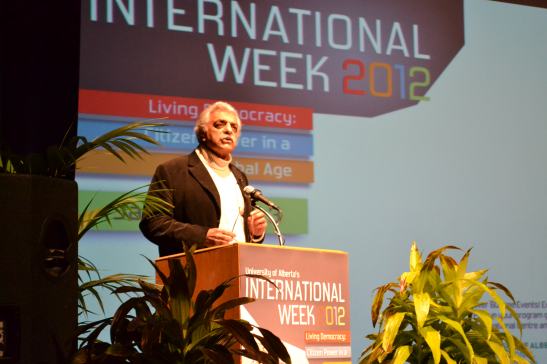
Tariq Ali’s keynote lecture on Monday wasn’t what I expected it to be. He’s a British-Pakistani journalist, historian, and filmmaker (and novelist, interestingly). He’s pretty well-known for his sharp writing in places like the Guardian, cutting Western governments to pieces for launching imperialist adventures. But his talk was less anchored to any specific political moments than I thought it would be.
Essentially, he laid out a map of the economic, ecological and political crises we’re all fairly familiar with. An economy divorced from any sensible idea of how to use it to make ecosystems healthier, chugging away on speculation upon speculation on the “fictitious commodity” of money (a term borrowed from our social theory friend Karl Polanyi). And of course a world run not by citizens, but by corporations and governments that pay lip service to our wishes through semi-regular rituals like elections.
“Hope is a very active emotion,” he said, though. “If you hope for something, it makes you active. In the struggle between despair and hope, I have all my life been on the side of hope. And I still am.”
Ali left with some observations about the frustration that leaves our generation with, feeling like we have no real choices except to vascillate occasionally between political masters who basically agree on the fundamentals of how markets and states should work. We are desperate for someone to answer our pleas when we take to the streets, he says, but there is no one out there to save us. It’s just us.

It seems like a bit of a nihilistic idea, but I think it’s also an empowering one. Anishinaabe activist and author Winona LaDuke brought up some similar ideas in her talk Monday night. She talked a lot about people on her reserve combatting the big energy issues by looking small, and trying to become more self-sufficient energy-wise through building small wind and solar projects on their land. Working with what they have. She also told stories about people working to heal their histories by going back and planting the seeds their ancestors did, and reclaiming the relationships they used to have taking care of the fish in their rivers. The stories said to me, whatever you lost, go back and get it.
There’s a Ghanaian proverb/symbol that says a similar thing: sankofa. It’s an Akan symbol that means — sort of — go back and get it. Reclaim what you lost.
There’s no one who can do that except us. If you can come to the rest of I-Week, running til February 3rd, I think you might pick up some great ideas on how to start.

 Chris Chang-Yen Phillips: Storyteller and People Weaver