Paleontology and Wildness as Heritage Performance in the Burgess Shale

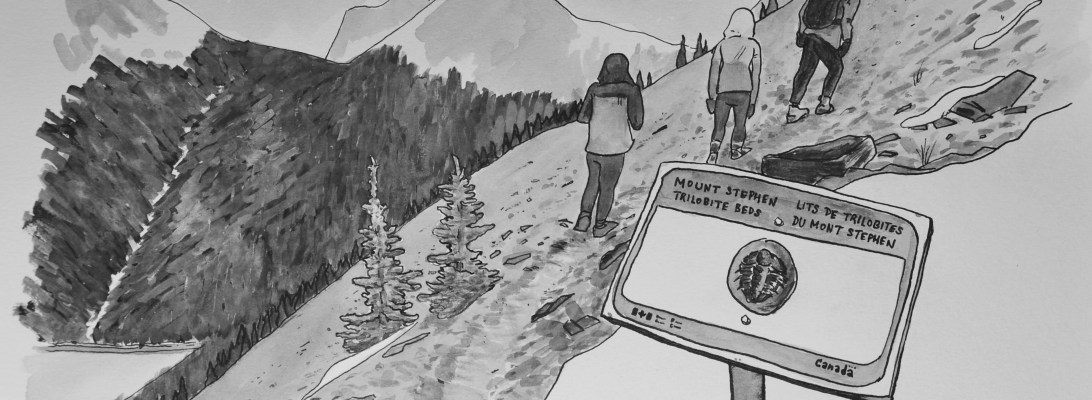
Hikers walking up to the Mount Stephen Trilobite Beds in Yoho (illustration by Chris Chang-Yen Phillips).

This is an academic presentation about my masters research, delivered at the AMPS Prague – Heritages conference on June 29, 2023.

High in the Rocky Mountains of Canada’s Yoho National Park, the Burgess Shale fossil beds demonstrate dilemmas presented by fossil-rich World Heritage Sites. Designated in 1980, the Burgess Shale bears remains of 500-million-year-old marine organisms that science writer Stephen Jay Gould (1990) once called “the world’s most important animal fossils.” While it was later absorbed into the Canadian Rocky Mountain Parks site, the designation continues to reverberate. It increased the importance of the Burgess Shale’s “discovery” in 1909 as part of regional identity and mythmaking in the Rocky Mountain parks. It also increased fossil theft and led to tighter Parks Canada access restrictions.

If, as Phillip and April Vannini (2021) argue, wildness is not an innate property but “an emergent outcome of activity, of performance, of inhabitation,” then wildness here seems to be a performance of scientific research, and tightly regulated interpretive hikes.

In this paper I will show that like other “natural” heritage sites in Canada (such as Joggins and Dinosaur Provincial Park), the Burgess Shale’s heritage value equally springs from past research conducted at the site, and ongoing reverence by those who hike up to seek physical contact with the deep past. As Patrick Boylan (2008) has noted, few sites have been designated for their geological importance alone, and fewer still for the richness of their fossils. I will argue that World Heritage designation can expose the relative power of interest groups making claims on fossil sites.

This presentation includes elements from my thesis research, being conducted at the University of Alberta under the supervision of Dr. Liza Piper.
Is Edmonton a prairie city?

One of my favourite parts of making Let’s Find Out is taking on questions that have never even occurred to me. The latest episode is a great example of that.

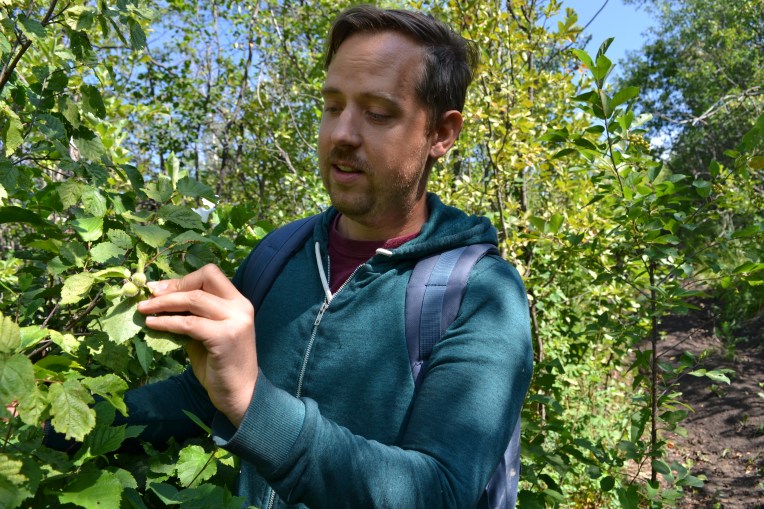
Dustin Bajer (a friend of mine from back in the Shareable Neighbourhood days who I love chatting with about nature) was the curious Edmontonian for this episode. He asked how Edmonton came to be known as a prairie city.

Dustin holds up a leaf, with many trees behind him
Dustin at the Coates Conservation Area, not far outside Edmonton city limits. We headed there to get a picture of what an undisturbed or old growth area here might look like.

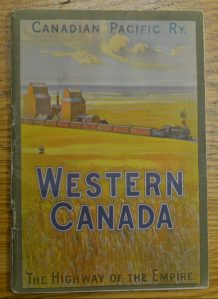
A guide entitled "Western Canada" produced by Canadian Pacific Railways
We went to the Bruce Peel Special Collections at the University of Alberta to examine old pamphlets and magazines produced by railways and the Canadian government, enticing settlers out West.

When I first read his question, it made my brain spin. In school we were taught that this region is part of the Aspen parkland biome – a mix of grasslands and deciduous forests. But you do see Edmonton businesses and artists taking on the “prairie” label all the time. So how far back does that reputation go?

Figuring out the answer was incredibly complicated. We found seemingly contradictory answers from old newspaper editorials, advertising materials aimed at prospective settlers, a local land conservation organization, and traditional Indigenous knowledge keepers. To parse it all, we ended up paying close attention to how far out we were zooming with our historical lens. What matters most? The last 50 years? 200? 10 000?

I’m proud of the nuance and struggle in this episode. It feels authentic to the process of answering any good historical question. There tend to be a lot of caveats and assumptions we need to examine.

Also any episode where I get to go hiking and learn some new words is a treat.

Thanks for letting me be your historian laureate, Edmonton

Today is my last real day as Edmonton’s 4th Historian Laureate. It’s been an honour, and it’s been a blast. So many amazing Edmontonians have made my work possible. I just want to shine a little light on some of them.

I am eternally grateful to City Council, the Edmonton Historical Board, and the Edmonton Heritage Council for believing in me. Support from the EHB and the EHC allowed me to dedicate the necessary time crafting each episode, and also allowed me to work with Doug Hoyer on the music, Andrea Hirji on the logo, and Samantha Power and Oumar Salifou on production. It’s been such a fun podcast to develop, and I can’t wait to get to work on the many cases ahead.

We’ve had so many brave question-askers on Let’s Find Out. I would never have learned the story of Frank Beevers and his missing gravestone if Sheila Thomas hadn’t asked about it. I wouldn’t have met Elder Jimmy O’Chiese and learned about offering protocol if Nathan Smith hadn’t been curious about relationships with plants in this area.

And of course, each story only sings if someone is willing to share what they know. Folks like Kisha Supernant, Siu To, and Carmen-Lida Ordoñez have been so generous with sharing their stories and their work.

Behind the scenes, a whole raft of archivists helped me brainstorm directions for research. I am especially grateful to Kathryn Ivany, Melissa McCarthy, Elizabeth Walker, and Tim O’Grady for that.

I also appreciate other media folks helping spread the word about Let’s Find Out stories, like Dave Cournoyer at Daveberta, Karen Unland with Seen and Heard in Edmonton, Alex Boyd at Metro, Kyle Muzyka and Ariel Fournier at CBC, and Shallima Maharaj at Global.

The podcast was my main project as historian laureate, but I was able to take on some very cool other projects as well. Fabiola Carletti roped me into a fascinating series of history stories for CBC. CJSR and the team there made it possible for me to help lead a climate change radio camp, and supervise a group of University of Alberta students making radio stories about Edmonton’s Chinatown for a project called Figure 一,二,三,六,八. And that project owes a lot to the hard work of Shawn Tse, Jinzhe Cui, and Lan Chan-Marples.

All three previous historians laureate were very helpful with advice when I needed it, so thanks to Danielle Metcalfe-Chenail, Shirley Lowe, and Ken Tingley for that.

Behind almost every episode of Let’s Find Out is a connection or two from Kyla Tichkowsky, and a lot of painting and shopping and soundproofing and listening from my very patient husband Finn.

And I owe a big thank you to Ian Moore and Kathryn Lennon, who encouraged me to apply in the first place.

This list is of course not even close to complete, but I hope it helps me make the point that nobody does this work alone.

I wish all the best to the next historian laureate. I can’t wait to see what they come up with in animating Edmonton’s stories.