To the end, my dear

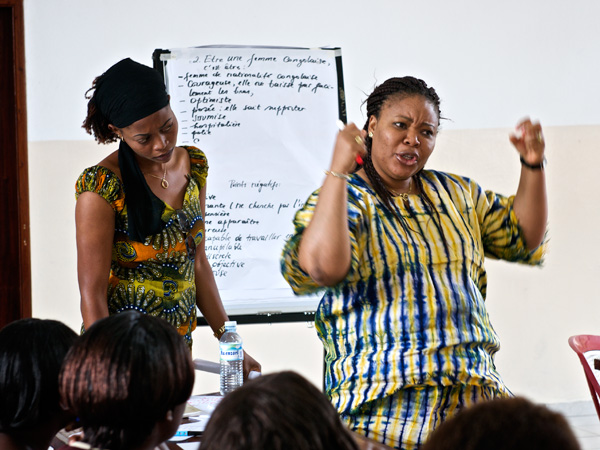
Nobel Peace Prize winner Leymah Gbowee stands in front of a white board with her hands raised like she's trying to push the crowd into action.
Nobel Peace Prize Laureate Leymah Gbowee confided that Archbishop Desmond Tutu warned her to watch her words carefully after winning, since they’d instantly be published on the internet (Photo by Alissa Everett)

Last night, my friend Evan and I had the pleasure of seeing Nobel Peace Prize winners Leymah Gbowee and Tawakkol Karman speak at the University of Alberta’s Festival of Ideas. Gbowee is famous for her work leading a women’s movement that helped end the civil war in Liberia, but she’s based in Ghana these days. The first thing she said on stage was that she was thankful to the organizers for coordinating a trip that was as long and complicated “as going to space.”

Karman is renowned now for her work rallying Yemenis out on the streets to fight for their right to free expression, free speech, and to eventually to end the rule of President Ali Abdullah Saleh. As a journalist, activist, and mother of three she’s taken extraordinary risks to fight for civil rights in Yemen. She said even after the lives of her children were threatened, she took courage knowing that millions more youths would take to the streets if they were harmed. Incredible change is possible, she said, if you are willing to take on a cause and pursue it to the very end. Have a goal in mind, and make a path towards it.

Moreover, she said women need to take on the responsibility for finding a just place for themselves in Yemeni society.

“Women must be the leaders, not ask for leadership from anyone,” she said. “We don’t want gifts from anyone. We want what we deserve.”

Similarly, Gbowee’s life seems to be a story of recognizing a responsibility to step up to the plate when no one else can. After 2000, ten years after the Liberian civil war began, a movement of Christian and Muslim women was building around the country to call for peace. She had convinced many of them that this was their fight, and they wanted her to lead them. Gbowee said she must have quit fifty times, and each time she’d find 200 hundred women waiting outside her house, telling her it was time to go back to work.

It makes me wonder — how seriously do most of us take the idea that we’re the ones who need to step up to the plate to solve our big crises, and we must follow our work to the very end? That, as the Hopi poem (or maybe prophecy) goes, “We are the ones we’ve been waiting for”?

I have an uncomfortable sense that many of us engaged in environmental and social justice work find our milestones more in our efforts than our accomplishments.

The One-Way Door

A man crouches to squeeze through a doorway out of a dark room and into the light.
The Room of No Return, Elmina Castle, Ghana

In the Elmina slave castle in Ghana, where men and women were held in hellish prison cells waiting to be shipped to the New World, there is a room my friends and I were taught to call the Room of No Return. There is a door out of this room where people were herded out to the boats, a one-way door. I have been thinking a lot about death lately, and I have been thinking about the one-way door.

Isaak Kornelsen’s death, and the cycling town hall it inspired, got me thinking about how a death resonates with the people left behind. Does it change the way they see themselves, the world around them, I wondered? Or does it just make them pay attention for a moment?

And after that, I kept coming back. I interviewed a forensic entomologist in Vancouver who explained how insects can tell stories for the dead: the age of flies in a body can date the time of death, the species mix can tell you the location a body was moved from, and the blood in an insect’s crop can tell you who… well, who they were eating. After that, my friend Alison and I organized a Shareable Neighbourhood walk to explore nature’s cycles of life and death (it hasn’t happened yet — that’s this Saturday). How do the trees and animals around us cope with the long, cold, winter in this climate? Which ones die, and which ones hang on, and how?

I’ve been trying to piece together why I’ve been drawn to these ideas lately, and the best I can come back to is the door. As JK Rowling showed so painfully in Harry Potter, death is at least a one-way passage for knowledge. We can never know what lies on the other side: a long drop and a short stop, or an ocean of possibility.

What does it mean to pass through a door with no hope of return? With no knowledge of what comes next? We know, of course, the grim life that lay on the other side of that particular door in the slave castle. But what if we were presented with such a door today, with no knowledge of what lay on the other side, and had the choice to take a one-way journey through it? Would we take it?

I watched the movie Solaris tonight, and it certainly asks this question. I think many great science fiction movies do, actually. Characters are presented with the choice to step onto an unknown, possibly transcendent, and possibly fatal path. There is no turning back.

I always get a tingle when they do.

Many of us live our lives with some certainty about the one-way door. It brings many people comfort to think that heaven lies on the other side, that all of our pain and wrongs will be erased and we can join the people we love again there. Others are just as certain that all that’s ahead of us is a future as a meal for insects. I don’t think it’s possible for us to know, no matter how many ghost stories I hear. But I think the answer we hold in our hearts matters.

If you were certain there a chance of eternal happiness on the other side, what matters more than getting there? Live your life without sin, do some good deeds where you can, and make right with your Creator, and everything will turn out alright. But what if all that’s on the other side is darkness? For some, that might mean there’s no point to living well. For me, I think it realigns life’s purpose.

If this is the only life we have, personal salvation doesn’t matter, but making this world better might. We may not have immortal life after this body expires, but we can certainly have an immortal impact on our community. If we are brave, we might embolden a whole generation after us. If we pay attention to our actions, we might make the water cleaner for our grandchildren. If we make space, new life might flourish in our footsteps.

The Next Step

I’m gratified to see the conversation has continued over how to keep traffic safe on Whyte Ave, and that my post here about Isaak Kornelsen helped spark conversation on Loop Frame Love and Green Edmonton. Among others, the writers on these two blogs have taken the observation of the poor cycling infrastructure on Whyte Ave and run with it (or pedaled with it, I suppose).

Conrad Nobert
Activist and educator Conrad Nobert is helping plan what comes next for cyclists on Whyte Ave.

It’s frustrating that it takes a tragedy to get serious discussion going about such basic safety issues in Edmonton right now. But I am pleased to see that Green Edmonton’s Conrad Nobert is taking the next step and organizing a town hall meeting where we can voice our opinions on what to do about Whyte Ave.

The Edmonton Bicycle Commuters will be there making a presentation on the possibilities before us, as will local city councillor Ben Henderson. I’ll be there covering the meeting for Terra Informa. Hope to see some of your faces in the room dreaming up what we want!

Cyclist Town Hall Meeting
Tuesday, September 25, 2012 – 7:30pm
Queen Alexandra Community Hall, 10425 University Ave (near Calgary Trail and 76th Avenue)