How a train car reminded me of cruelty and caring
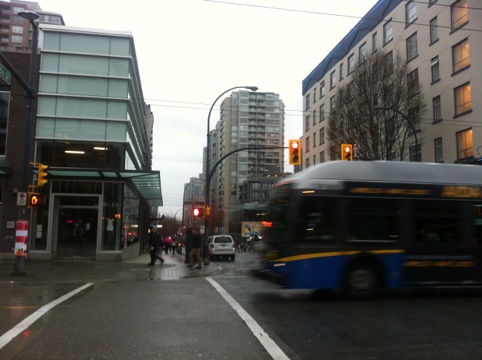
So I just got to Vancouver for a week-long sustainability conference. The first thing that hit me as I climbed up to the Sky Train was, thankfully, not a messy present from the apparently perpetually-circling seagulls. No, it was a memory and a thought about good and evil.
You see, my friend Jon wrote a great one-man show called Big Shot that zooms in and out of a shooting on the Sky Train. You meet all these characters that are part of this moment on the train, and start to feel less and less comfortable calling any of them “innocent” bystanders.
All of them have acted in morally ambiguous ways leading up to that instant, from a cop profiling people on the street to an old Japanese man pickpocketing from people he feels victimized by.
What the play said to me is that it’s incredibly easy for our moral order to be ripped away by one disruptive event, and that it doesn’t make sense to call people good or evil. The truth is that we’re all capable of both.
We’re capable of killing — violently, cruelly — but we’re also capably of building something new, of deep caring and altruism, as long as it makes sense to us. If you’ve seen The Dark Knight, think of the climax where the Joker gives two ferries full of passengers a bomb and a choice.
One is full of prisoners, the other is full of ordinary citizens. Both are given the switch that will detonate a bomb on the other boat. And they’re told that if one of them doesn’t press the button, they’ll both be blown up. I won’t give away what happens, but it shouldn’t surprise you that the passengers on each ferry start to seriously discuss the worth of the lives on the other.
Within a matter of minutes, a boat full of “good” people and a boat full of “bad” are both struggling to make their choice.
We could have a whole other discussion about how to define “good.” For right now I’ll leave that to my friend Dan the philosopher and say I mean something that’s generally useful to the community’s health and well-being and either helpful or not overly harmful to an individual.
What our political leaders think we’re capable of
Unfortunately, if you were to ask most of our political parties whether people are naturally good or bad, the honest ones would answer, “Bad, of course!”
Almost all of our laws and regulations are based on the worldview that people have inherently bad tendencies that must be tempered and restricted.
I’m not just talking about the logic behind the federal Conservatives’ strategy of answering crime with the threat of more and more severe mandatory jail time. You can also see this in the way we think about pollution. We assume that industries will pollute as much as they can get away with, so we set caps on emissions and runoff. Maximums.
Markets are mostly designed the opposite way: to harness people’s tendencies to want to consume, make a profit, and invest, and to channel that motivation to some desired end. The way this is structured in most societies ends up making some of us very rich and some of us very poor, of course.
But what if we took some lessons from this way of thinking, to positively harness our motivations?
Giving force multipliers to good
How can we reinforce and encourage the “good” things we’re capable of? What would that look like when city councillors sit together under a big glass pyramid and come up with policies?
What about setting a minimum threshold for a lumber mill to make their river healthier? It’s not so unreasonable to imagine a world where we have minimum quotas for the health and diversity of the species living in the river they sit beside.
What about setting up matching grants for business owners and residents who have an idea to make their neighbourhood more attractive with a new awning or some new benches?
Actually, that second idea has already worked in cities like Seattle and Portland, and a couple years ago Edmonton’s City Council was kicking around the same proposal.
I wrote a story about it at the time, when Councillor Janice Melnychuk set up a community investment fund for projects like that in Alberta Avenue. At the time, she was hoping that people living and working in the area would come up with proposals for things like public arts projects and new streetlamps. I haven’t had a chance to follow up with it since, and I’d be very interested to see where it’s at now.
What do you think? Does moving away from punishment-centred thinking mean encouraging hooliganism? What do you think we naturally are?

 While I was at the GLOBE Conference last week, someone mentioned I need to be less exasperated with people who don’t think the same way I do. The world needs some connectors, some mavens, and some… well some other things, she said.

 Chris Chang-Yen Phillips: Storyteller and People Weaver